


Page 247 - GHES-3-3
P. 247
Global Health Economics and
            Sustainability
                                                                               Empirical resource allocation in healthcare


            Table 3. Parameters of a power function approximating the empirical distribution of the number of hospital beds
            Parameter      2010       2011       2012       2013       2014        2015       2016       2017
            α             −0.481      −0.484     −0.487     −0.489     −0.472     −0.455     −0.455     −0.455
            R 2            0.887      0.888      0.901      0.901      0.905       0.933      0.932      0.922
            Note: α is the exponent of a power function approximating the empirical distribution of the parameter; R  is a coefficient of determination for a power
                                                                               2
            function approximating the empirical distribution of the parameter.
            Table 4. Parameters of a power function approximating the empirical distribution of the number of hospital beds per 100,000
            population for the combined group of countries
            Parameter     2006      2007      2008      2009      2010      2011      2012     2013      2014
            α             −2.18     −2.17     −2.15     −2.13     −2.11     −2.09     −2.04    −2.00     −1.88
            R 2           0.861     0.845     0.856     0.883     0.920     0.929     0.916     0.928    0.924
            Note: α is the exponent of a power function approximating the empirical distribution of the parameter; R  is a coefficient of determination for a power
                                                                               2
            function approximating the empirical distribution of the parameter.


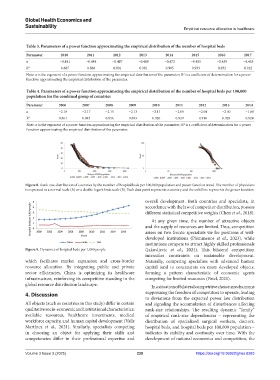
            Figure 8. Rank-size distribution of countries by the number of hospital beds per 100,000 population and power function trend. The number of physicians
            is expressed in a normal scale (A) or a double logarithmic scale (B). Each data point represents a country and the solid line represents the power function.

                                                               overall development. Both countries and specialists, in
                                                               accordance with the law of competitor distribution, possess
                                                               different statistical competitive weights (Chen et al., 2018).
                                                                 At any given time, the number of attractive objects
                                                               and the supply of resources are limited. Thus, competition
                                                               arises on two fronts: specialists vie for positions at well-
                                                               developed institutions (Plemmenos  et  al., 2023), while
                                                               institutions compete to attract highly skilled professionals
            Figure 9. Dynamics of hospital beds per 1,000 people  (Jakovljevic  et al.,  2024).  This  bilateral  competition
                                                               intensifies constraints on sustainable development.
            which facilitates market expansion and cross-border   Naturally, competing specialists with advanced human
            resource allocation. By integrating public and private   capital tend to concentrate on more developed objects,
            sector efficiencies, China is  optimizing  its healthcare   forming  a pattern characteristic  of economic  agents
            infrastructure, reinforcing its competitive standing in the   competing for limited resources (Patel, 2021).
            global resource distribution landscape.              In a situation of bilateral competitive choice, mechanisms
            4. Discussion                                      suppressing the freedom of competitors to operate, leading
                                                               to deviations from the expected power law distribution
            All objects (such as countries in this study) differ in certain   and signaling the accumulation of disturbances affecting
            qualitative socio-economic and institutional characteristics:   rank-size relationships. The resulting dynamic “family”
            available resources, healthcare investments, medical   of empirical rank-size dependencies – representing the
            workforce capacity, and human capital development (Valls   distribution of specialized surgical workers, doctors,
            Martínez  et al., 2021). Similarly, specialists competing   hospital beds, and hospital beds per 100,000 population –
            in choosing an object for applying their skills and   indicates its stability and continuity over time. With the
            competencies differ in their professional expertise and   development of national economies and competition, the


            Volume 3 Issue 3 (2025)                        239                       https://doi.org/10.36922/ghes.8283

