


Page 282 - GHES-3-3
P. 282
Global Health Economics and
            Sustainability
                                                                             Carbon footprint of smartphones in healthcare


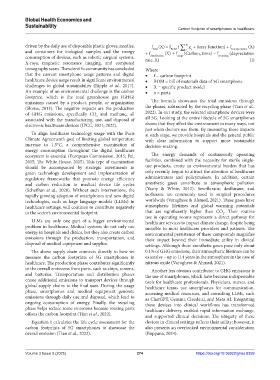
            driven by the daily use of disposable plastic gloves, needles,   f  (X) = f BOM ∑ N x + fuzzy function) + f   (X)
                                                                             (
                                                                                                   transportation
                                                                                  i
                                                                                i
            and containers for biological samples and the energy   + f  total    (X) + f  (Carbon, time) − f   (depreciation
                                                                 distribution
            consumption of devices, such as robotic surgical systems,   rate, X)   usage      recycling    (I)
            X-rays, magnetic resonance imaging, and computed
            tomography scans. The scientific community has concluded   Where
            that the current smartphone usage patterns and digital   •   f = carbon footprint
            healthcare device usage result in significant environmental   •   BOM = bill of materials data of 5G smartphone
            challenges  to  global  sustainability  (Ripple  et  al.,  2017).   •   X = specific product model
            An example of an environmental challenge is the carbon   •   x = parts
            footprint,  which  is  the  total  greenhouse  gas  (GHG)
            emissions caused by a product, people, or organization   The formula showcases the total emissions through
            (Słoma,  2013).  The  negative  impacts  are  the  production   the phases, subtracted by the recycling phase (Tian et al.,
            of GHG emissions, specifically CO  and methane, all   2022). In our study, the selected smartphone devices were
                                          2
            associated  with  the  manufacturing,  use,  and  disposal  of   all 5G. Looking at the entire lifecycle of 5G smartphones
            electronic healthcare devices (IPCC, 2021; 2022).  shows that they affect the environment in many ways, not
                                                               just when doctors use them. By measuring these impacts
              To align healthcare technology usage with the Paris   at each stage, we provide hospitals and the general public
            Climate Agreement’s goal of limiting global temperature   with clear information to support more sustainable
            increase to 1.5°C, a comprehensive examination of   decision-making.
            energy consumption throughout the digital healthcare
            ecosystem is essential (European Commission, 2015; Pei,   The energy demands of continuously operating
            2015; The White House, 2015). This type of examination   facilities, combined with the necessity for sterile single-
            should  be accompanied  by strategic investments  in   use products, create an environmental burden that has
            green technology development and implementation of   only recently begun to attract the attention of healthcare
            regulatory frameworks that promote energy efficiency   administrators  and  policymakers.  In  addition,  certain
            and carbon reduction in medical device life cycles   anesthetic gases contribute to atmospheric pollution
            (Scheffran  et al.,  2020). Without  such  interventions,  the   (Yasny & White, 2012). Sevoflurane, desflurane, and
            rapidly growing adoption of smartphones and new digital   isoflurane are commonly used in surgical procedures
            technologies, such as large language models (LLMs) in   worldwide (Varughese & Ahmed, 2021). These gases have
            healthcare settings, will continue to contribute negatively   atmospheric lifetimes and global warming potentials
            to the sector’s environmental footprint.           that are significantly higher than CO . Their routine
                                                                                                2
                                                               use in operating rooms represents a direct pathway for
              LLMs are only one part of a bigger environmental   healthcare services to impact climate change, despite being
            problem in healthcare. Medical systems do not only use   invisible to most healthcare providers and patients. The
            energy in hospitals and clinics, but they also create carbon   environmental persistence of these compounds magnifies
            emissions through the production, transportation, and   their impact beyond their immediate utility in clinical
            disposal of medical equipment and supplies.        settings. Although these anesthetic gases pose only about
              The above supply chain connects directly to how we   0.1% of GHG emissions, their atmospheric lifetimes can be
            measure the carbon footprints of 5G smartphones in   extensive – up to 114 years in the atmosphere in the case of
            healthcare. The production phase contributes significantly   nitrous oxide (Varughese & Ahmed, 2021).
            to the overall emissions from parts, such as chips, screens,   Another less obvious contributor to GHG emissions is
            and batteries. Transportation and distribution phases   the use of smartphones, which have become indispensable
            create additional emissions to transport devices through   tools for healthcare professionals. Physicians, nurses, and
            global supply chains to the final user. During the usage   healthcare teams use smartphones for communication,
            phase, smartphones and medical equipment generate   accessing medical resources, and consulting LLMs, such
            emissions through daily use and disposal, which lead to   as ChatGPT, Gemini, Claude.ai, and Meta AI. Integrating
            ongoing  consumption  of  energy.  Finally,  the  recycling   these devices into clinical workflows has transformed
            phase helps reduce some emissions because reusing parts   healthcare delivery, enabled rapid information exchange,
            offsets the carbon footprint (Tian et al., 2022).  and supported clinical decisions. The ubiquity of these
              Equation I calculates the life cycle assessment for the   devices in clinical settings reflects their utility; however, it
            carbon footprints of 5G smartphones to showcase the   also presents an overlooked environmental consideration
            overall emission (Tian et al., 2022).              (Boppana, 2024).


            Volume 3 Issue 3 (2025)                        274                       https://doi.org/10.36922/ghes.8359

