


Page 285 - GHES-3-3
P. 285
Global Health Economics and
            Sustainability
                                                                             Carbon footprint of smartphones in healthcare


            make decisions that align with responsible management of   LLMs are trained on public data, reinforcement learning,
            the environment. As healthcare systems around the world   and the internet, they should have answers to our queries.
            strive for sustainability, it is essential to comprehend all   We then compare the actual data from the CSR reports to
            the elements that affect the environment, including the   the LLM answers.
            digital tools that physicians and patients use on a daily   The LLM query is: “What is the average carbon footprint
            basis. This study is intended for physicians and healthcare   of the entire lifecycle of (smartphone model)?”  These
            professionals, aiming to contribute to the growing body of   queries were conducted for flagship devices, including the
            knowledge about smartphones and their carbon footprint.
                                                               Apple iPhone 14, 15, and 16 series, as well as the Samsung
            2. Methods                                         Galaxy S24 series, Z Flip6, and Z Fold6.

            We chose Apple and Samsung smartphones since they    In addition, we asked the same queries to smart home
            are the most popular smartphones in terms of sales and   devices to determine if they produced any emissions as
            shipment market share in the United States (Counterpoint   individual household assistants. We conducted the same test
                                                                                    nd
            Research, 2025). Carbon emissions data for flagship   described above using the 2  generation of Apple HomePod
            smartphones from Apple and Samsung were obtained   and the latest versions of Google Home and Echo.
            from publicly available sources, including CSR reports,   The LLM responses were compared directly to the
            official  corporate  websites,  and  product  environmental   emissions data reported by Apple and Samsung. If the LLM
            reports (Apple Inc., 2024; Samsung Electronics, 2024).  model failed to provide an answer or explained that the
              The designation of “actual emissions data” was based   data were publicly available, it was noted as a missing data
            on the corporate materials of each company. For Apple   point. To quantify the accuracy of each model, the percent
            devices, we obtained the carbon footprint values directly   error was calculated using Equation II.
            from Apple’s official product environmental reports (Apple
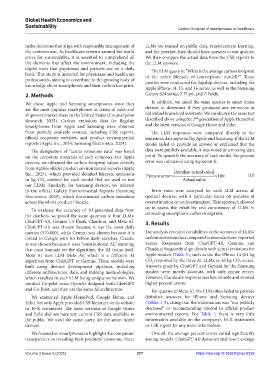
            Inc., 2025), which provided detailed lifecycle emissions   Percenterror=  AIvalue-actualvalue  ×100  (II)
            in kg CO  emitted for each model that we used to test              Actualvalue
                    2
            our LLMs. Similarly, for Samsung devices, we referred
            to the official Galaxy Environmental Reports (Samsung   Error rates were analyzed for each LLM across all
            Electronics, 2025), which documented carbon emissions   queried devices, with a particular focus on patterns of
            across the whole product lifecycle.                overestimation or underestimation. This approach allowed
                                                               us  to  assess  the  reliability  and  consistency  of  LLMs  in
              To evaluate the accuracy of AI-generated data from
            the chatbots, we posed the same question to four LLMs:   estimating smartphone carbon footprints.
            ChatGPT-4.0, Gemini 1.5 Flash, Claude.ai, and Meta AI.   3. Results
            ChatGPT-4.0 was chosen because it has the most daily
            queries (570,000), while Gemini was chosen because it is   The analysis revealed variabilities in the accuracy of LLMs’
            linked to Google with 8.5 billion daily searches. Claude.  carbon emissions data compared to manufacturer-reported
            ai was chosen because it uses “constitutional AI,” meaning   values.  Responses  from  ChatGPT-4.0,  Gemini,  and
            that once humans set the algorithm, the AI trains itself.   Claude.ai frequently align closely with actual emissions for
            Meta AI uses LLM Meta AI, which is a different AI   Apple models (Table 1), such as the the iPhone 14 (61 kg
            algorithm from ChatGPT or Gemini. These models were   CO ) reported by the three AI-LLMs vs. 61 kg CO₂ actual.
                                                                  2
            built using distinct development pipelines, including   Answers given by ChatGPT and Gemini for the Samsung
            different architectures, data, and training methodologies,   models were mostly accurate, with only minor errors.
            which resulted in each LLM being unique on its own. We   However, Claude.ai’s response was less reliable and showed
            omitted Co-pilot since OpenAI designed both ChatGPT   higher percent errors.
            and Co-Pilot, and they use the same AI architecture.  For queries to Meta AI, the LLM often failed to provide
              We examined Apple HomePod, Google Home, and      definitive answers for iPhone and Samsung devices
            Echo, but only Apple provided CSR literature on its website   (Tables 1-3), citing that the information was “not publicly
            or 10-K statements. The latest versions of Google Home   disclosed” or recommending referral to official product
            and Echo did not have any current CSR data available to   environmental  reports.  For  Table  1,  there  is very little
            the public. We used the same query for the smart home   information available on the company’s 10-K statements
            devices.                                           or CSR report for any more information.
              We focused on smartphones to highlight the companies’   Overall, the average percent errors varied significantly
            transparency in revealing their products’ emissions. Since   among models. ChatGPT-4.0 demonstrated lower average


            Volume 3 Issue 3 (2025)                        277                       https://doi.org/10.36922/ghes.8359

