


Page 69 - GHES-3-3
P. 69
Global Health Economics and
            Sustainability
                                                                                        Pharmaceutical system in Iraq


            medicines, and food supplements (Al-Jumaili et al., 2013;   Scientific bureaus are private enterprises registered with
            Al-Lela et al., 2012). The DTA is responsible for licensing   the SIP that is responsible for the promotion and trading of
            establishments,  issuing  marketing  authorizations,  pharmaceuticals across the nation. They often serve as local
            conducting regulatory inspections, performing laboratory   representatives for foreign pharmaceutical companies.
            testing (quality control and assurance), overseeing batch   These  bureaus  procure  pharmaceutical  products  directly
            releases, and managing pharmacovigilance. It comprises   from domestic and international manufacturers and sell
            several technical committees, departments, and centers,   them to public entities (e.g., KIMADIA, Directorates of
            operated by specialist physicians and pharmacists   Health,  and  public  hospitals),  wholesale  pharmaceutical
            (Figure  1) (Al-Jumaili  et al., 2013; Al-Lela  et al., 2012;   suppliers, and, in some cases, through “irregular” pathways,
            Republic of Iraq Ministry of Health, 2020).        to community pharmacies (Figure  2) (Al-Jumaili  et al.,
            3.2. Structure of the private sector               2013; United States of America Department of Commerce,
                                                               2018). While it is not mandatory for a foreign company
            The private pharmaceutical sector differs from the public   to have a local agent or representative to participate in
            sector in terms of structure, role, size, and procurement   KIMADIA tenders, companies represented by a scientific
            model (Figure 2) (Al Hilfi et al., 2013; Al Hasnawi et al.,   bureau are generally favored by KIMADIA (Republic of
            2009). It comprises three main entities (scientific bureaus,   Iraq Ministry of Health, n.d.a; United States of America
            wholesale pharmaceutical suppliers, and community   Department of Commerce, 2018). The customer portfolio
            pharmacies), which differ in role and size and are   of scientific bureaus may include both public and private
            responsible for the distribution of medicines and medical   sector clients (Figure  2) (Republic of Iraq Ministry of
            appliances in the private market (Al-Jumaili et al., 2013;   Health, 2020).
            Management  Partners, 2013;  Rasheed &  Abbas, 2017).
            The Syndicate of Iraqi Pharmacists (SIP) is authorized   Wholesale  pharmaceutical suppliers are  private
            to establish the rules and regulations for licensure and   enterprises that procure medicines mainly from scientific
            inspection of private distributors (Al-Jumaili et al., 2013;   bureaus or domestic pharmaceutical manufacturers and
            Syndicate  of  Iraqi  Pharmacists,  2023),  although  the   sell directly to private dispensaries, such as community
            MoH, through the Inspection Department/DTA, retains   pharmacies and private healthcare facilities (Al-Jumaili
            oversight and monitoring responsibilities for the private   et  al., 2013; Management Partners, 2013). In certain
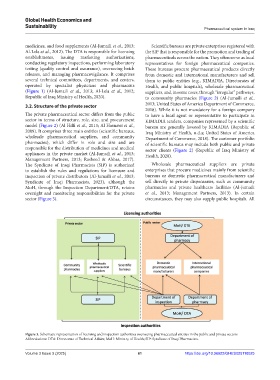
            sector (Figure 3).                                 circumstances, they may also supply public hospitals. All


            Figure 3. Schematic representation of licensing and inspection authorities overseeing pharmaceutical entities in the public and private sectors
            Abbreviations: DTA: Directorate of Technical Affairs; MoH: Ministry of Health; SIP: Syndicate of Iraqi Pharmacists.


            Volume 3 Issue 3 (2025)                         61                  https://doi.org/10.36922/GHES025110025

