


Page 73 - GHES-3-3
P. 73
Global Health Economics and
            Sustainability
                                                                                        Pharmaceutical system in Iraq


              As Iraq strives to expand and modernize its domestic   Domestic medicines are the most demanded and
            pharmaceutical industry, it is also shifting from a   trusted among the Iraqi population due to their
            centralized, state-based regimen to a decentralized   technical and scientific standards, as well as their proven
            one, with greater involvement from the private sector   medicinal efficiency compared to some imported
            (Al-Mosawi, 2020; Republic of Iraq Ministry of Health,   medicines (Al lami  et al., 2017). The preference
            2019a). Various international pharmaceutical companies   for domestic products is further driven by their
            are now marketing and trading their products in Iraq   competitive prices and the low risk of S/F medicines,
            (Al-Jumaili  et al., 2013;  Republic  of  Iraq Ministry of   which are much rarer for domestically manufactured
            Health, 2019a). By the end of 2020, Iraq had 23 domestic   medicines compared to imported ones (Al-Hiti, 2019;
            pharmaceutical manufacturers (two public and 21 private),   Al Iami et al., 2017; Al-Jumaili  et al., 2013; Republic
            which accounted for 47.8% of the total volume in the
            public sector (Ahmed et al., 2020; Al-Hiti, 2019). However,   of Iraq Ministry of Health, 2019a). In response to
            these manufacturers do not produce active pharmaceutical   the COVID-19 pandemic, domestic pharmaceutical
            ingredients, biopharmaceuticals, or WHO-prequalified   producers attempted to scale up and expand their
            products (Ahmed et al., 2020; Republic of Iraq Ministry   portfolio, particularly in COVID-19-related medicines
            of  Health,  2020).  The  MoH  oversees  the  licensing  and   and consumables (Al-Jumaili  et al., 2021). However,
            inspection of national manufacturers through the   these efforts were deemed insufficient in reaction speed
            Department  of Pharmacy/DTA and the  Directorate of   and quantity, which meant that the country remained
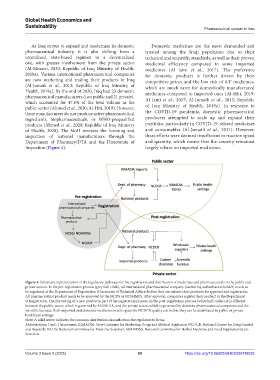
            Inspection (Figure 4).                             largely reliant on imported medicines.


            Figure 4. Schematic representation of the regulatory pathways for the registration and distribution of medicines and pharmaceuticals in the public and
            private sectors. In the pre-registration process (grey half circle), all international pharmaceutical company (marketing authorization holder) needs to
            be registered at the Department of Registration (Directorate of Technical Affairs) before they can submit their products for approval and registration.
            All pharmaceutical product needs to be approved by the NCDS or NCSHMFS. After approval, companies register their product in the Department
            of Registration. Quality testing of a new product is part of the registration process. In the post-registration process (white half circles), it is different
            between the public sector, which is governed by KIMADIA, and the private sector, which is governed by domestic pharmaceutical companies and the
            scientific bureaus. Both imported and domestic medicines need to pass the NCDCR quality test before they can be distributed to public or private
            healthcare settings.
            Note: A solid arrow indicates the common distribution channels from the regulators to firms.
            Abbreviations: Dept.: Department; KIMADIA: State Company for Marketing Drugs and Medical Appliance; NCDCR: National Centre for Drug Control
            and Research; NCDS: National Committee for Medicine Selection; NCHMFSS: National Committee for Herbal Medicine and Food Supplementation
            Selection.


            Volume 3 Issue 3 (2025)                         65                  https://doi.org/10.36922/GHES025110025

