


Page 88 - GPD-2-2
P. 88
Gene & Protein in Disease                                    Verteporfin therapy for triple-negative breast cancer


             A                  B                            C                   D


             E


             F                                                     G


             H                                                      I


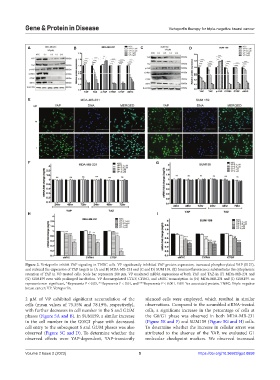
            Figure 2. Verteporfin inhibit YAP signaling in TNBC cells. VP significantly inhibited YAP protein expression, increased phosphorylated YAP (S127),
            and reduced the expression of YAP targets in (A and B) MDA-MB-231 and (C and D) SUM 159. (E) Immunofluorescence substantiates the cytoplasmic
            retention of YAP in VP-treated cells. Scale bar represents 200 µm. VP unaltered mRNA expressions of both YAP and TAZ in (F) MDA-MB-231 and
            (G) SUM159 even with prolonged incubation. VP downregulated CTGF, CYR61, and cMYC transcription in (H) MDA-MB-231 and (I) SUM159. ns
            represents non-significant, *Represents P < 0.05, **Represents P < 0.01, and ***Represents P < 0.001. YAP: Yes-associated protein; TNBC: Triple-negative
            breast cancer; VP: Verteporfin.

            2  µM  of  VP  exhibited  significant  accumulation  of  the   silenced cells were employed, which resulted in similar
            cells  (mean  values  of  75.35%  and  78.19%,  respectively),   observations. Compared to the scrambled siRNA-treated
            with further decreases in cell number in the S and G2/M   cells, a significant increase in the percentage of cells at
            phases (Figure 5A and B). In SUM159, a similar increase   the G0/G1 phase was observed in both MDA-MB-231
            in the cell number in the G0/G1 phase with decreased   (Figure 5E and F) and SUM159 (Figure 5G and H) cells.
            cell entry to the subsequent S and G2/M phases was also   To determine whether the increase in cellular arrest was
            observed (Figure  5C and  D). To determine whether the   attributed  to  the  absence  of  the  YAP,  we  evaluated  G1
            observed effects were YAP-dependent, YAP-transiently   molecular checkpoint markers. We observed increased


            Volume 2 Issue 2 (2023)                         5                        https://doi.org/10.36922/gpd.0658

