


Page 67 - GPD-3-1
P. 67
Gene & Protein in Disease                                             In silico application of the CoM method


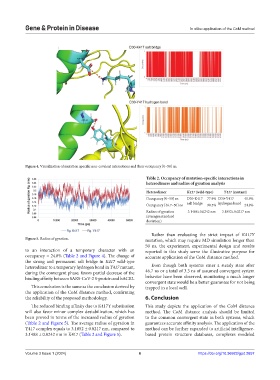
            Figure 4. Visualization of mutation specific non-covalent interactions and their occupancy [0–50] ns.
                                                               Table 2. Occupancy of mutation‑specific interactions in
                                                               heterodimers and radius of gyration analysis
                                                               Heterodimer       K417 (wild‑type)  Y417 (mutant)
                                                               Occupancy [0–50] ns   D30-K417  77.9% D30-Y417   41.9%
                                                               Occupancy [46.7–50] ns  salt bridge  98.5%  hydrogen bond  24.8%
                                                               Radius of gyration   3.1488±0.0242 nm  3.1852±0.0217 nm
                                                               (average±standard
                                                               deviation)


                                                                 Rather than evaluating the strict impact of  K417Y
            Figure 5. Radius of gyration.                      mutation, which may require MD simulation longer than
                                                               50 ns, the experiment, experimental design and results
            to an interaction of a temporary character with an   reported in  this  study serve the  illustrative purpose  for
            occupancy = 24.8% (Table 2 and Figure 4). The change of   accurate application of the CoM distance method.
            the  strong  and permanent  salt  bridge  in  K417  wild-type
            heterodimer to a temporary hydrogen bond in Y417 mutant,   Even though both systems enter a steady state after
            during the convergent phase, favors partial decrease of the   46.7 ns or a total of 3.3 ns of assumed convergent system
            binding affinity between SARS-CoV-2 S-protein and hACE2.  behavior have been observed, monitoring a much longer
                                                               convergent state would be a better guarantee for not being
              This conclusion is the same as the conclusion derived by   trapped in a local well.
            the application of the CoM distance method, confirming
            the reliability of the proposed methodology.       6. Conclusion
              The reduced binding affinity due to K417Y substitution   This  study depicts  the  application  of  the  CoM  distance
            will also favor minor complex destabilization, which has   method.  The  CoM  distance  analysis  should  be  limited
            been proved in terms of the increased radius of gyration   to the common convergent state in both systems, which
            (Table 2 and Figure 5). The average radius of gyration in   guarantees accurate affinity analysis. The application of the
            Y417 complex equals to 3.1852 ± 0.0217 nm, compared to   method can be further expanded to artificial intelligence-
            3.1488 ± 0.0242 nm in K417 (Table 2 and Figure 5).  based protein structure databases, complexes modeled


            Volume 3 Issue 1 (2024)                         6                        https://doi.org/10.36922/gpd.2657

