


Page 10 - GPD-3-3
P. 10
Gene & Protein in Disease                                         Comprehensive analysis of ZNF521/Zfp521


            produce iNSCs by ectopically expressing the neurogenic   modifications  (Figure 3). Zfp521 can achieve epigenetic
                                                                          45
            factor ZFN521. 16                                  effects through the overall remodeling of the nucleus.
              Zfp521 impairs the development of normal B cells by   However, for ZNF521/Zfp521, their N-terminal is
            inhibiting its  target  genes  GATA1  and  EBF1-mediated   regulated by acetylation, 10,13,46  and their N-terminals
            differentiation process. 1,22,37,38  Early B cell factor (EBF) is a   contain a 12-amino acid sequence called nuclear
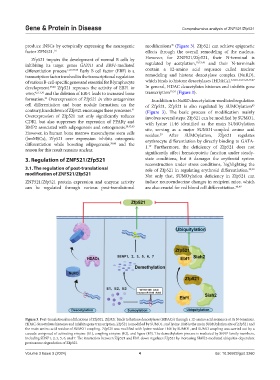
            transcription factor involved in the transcriptional regulation   remodeling and histone deacetylase complex (NuRD),
            of various B-cell-specific genes and essential for B lymphocyte   which binds to histone deacetylases (HDACs). 6-8,10-13,15,25,37,47
            development. 39,40   Zfp521  represses  the  activity of EBF1  in   In general, HDAC deacetylates histones and inhibits gene
            vitro, 4,5,13,30  and the deletion of EBF1 leads to increased bone   transcription 19,24  (Figure 3).
            formation.  Overexpression of Zfp521 in vitro antagonizes   In addition to NuRD deacetylation-mediated regulation
                    24
            cell differentiation and bone nodule formation; on the   of Zfp521, Zfp521 is also regulated by SUMOylation
                                                                                                            45
            contrary, knockdown of Zfp521 encourages these processes.    (Figure  3).  The  basic  process  of  modification  mainly
                                                         41
            Overexpression of Zfp521 not only significantly reduces   involves several steps: Zfp521 can be modified by SUMO1,
            CDK1 but also suppresses the expression of PPARγ and   with lysine 1146 identified as the main SUMOylation
            BMP2 associated with adipogenesis and osteogenesis. 20,42,43    site,  serving  as  a  major  SUMO1-coupled  amino  acid
            However, in human bone marrow mesenchyme stem cells   residue. 29  After  SUMOylation,  Zfp521  regulates
            (bmMSCs), Zfp521 over expression inhibits osteogenic   erythrocyte differentiation by directly binding to GATA-
            differentiation while boosting adipogenesis, 30,44  and the   1.  Furthermore, the deficiency of Zfp521 does not
                                                                29
            reason for this result remains unclear.
                                                               significantly affect hematopoietic function under steady-
            3. Regulation of ZNF521/Zfp521                     state conditions, but it damages the erythroid system
                                                               reconstruction  under  stress  conditions,  highlighting  the
            3.1. The regulation of post-translational          role of Zfp521 in regulating erythroid differentiation. 29,48
            modification of ZNF521/Zfp521                      Not only that, SUMOylation deficiency in Zfp521 can

            ZNF521/Zfp521 protein expression and enzyme activity   induce neuroendocrine changes in recipient mice, which
            can be regulated through various post-translational   are also crucial for red blood cell differentiation. 48,49


            Figure 3. Post-translational modifications of Zfp521. Zfp521 binds to histone deacetylases (HDACs) through a 12-amino acid sequence at its N-terminus.
            HDAC deacetylates histones and inhibits gene transcription. Zfp521 is modified by SUMO1, and lysine 1146 is the main SUMOylation site of Zfp521 and
            the main amino acid residue of SUMO1 coupling. Zfp521 was modified with lysine residue 1146 by SUMO1, and SUMO coupling was carried out by a
            cascade composed of activating enzyme (E1), coupling enzyme (E2), and ligase (E3). The demethylation process is mediated by SENP family members,
            including SENP1, 2, 3, 5, 6, and 7. The interaction between Zfp521 and Ebf1 down regulates Zfp521 by increasing SIAH2-mediated ubiquitin-dependent
            proteasome degradation of Zfp521.

            Volume 3 Issue 3 (2024)                         4                               doi: 10.36922/gpd.3260

