


Page 8 - GPD-3-3
P. 8
Gene & Protein in Disease                                         Comprehensive analysis of ZNF521/Zfp521


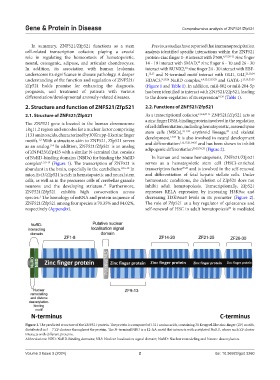
              In summary, ZNF521/Zfp521 functions as a stem      Previous studies have reported that immunoprecipitation
            cell-related transcription cofactor, playing a crucial   analysis identified specific interactions within the ZNF521
            role in regulating the homeostasis of hematopoietic,   protein: zinc finger 1- 8 interact with P300, 6,15,20-22  zinc finger
            neural, osteogenic, adipose, and articular chondrocytes.   14 - 19 interact with SMAD,  zinc finger 6 - 10 and 26 - 30
                                                                                     23
            In addition, its association with human leukemia   interact with RUNX2,  zinc finger 24 - 30 interact with EBF-
                                                                                24
            underscores its significance in disease pathology. A deeper   1, 12,13  and N-terminal motif interact with GLI1, GLI, 23,10,14
            understanding of the function and regulation of ZNF521/  HDAC3, 9,15,24  NuRD complex, 6,9,12,13,15,25  and GATA-1 13,15,23,25
            Zfp521 holds promise for enhancing the diagnosis,   (Figure 1 and Table 1). In addition, miR-802 or miR-204-5p
            prognosis, and treatment of patients with various   has been identified to interact with ZNF521/Zfp521, leading
            differentiation/developmental anomaly-related diseases.  to the down-regulation of its expression 10,26  (Table 1).

            2. Structure and function of ZNF521/Zfp521         2.2. Functions of ZNF521/Zfp521
            2.1. Structure of ZNF521/Zfp521                    As a transcriptional cofactor, 13,14,27-31  ZNF521/Zfp521 acts as
                                                               a zinc finger DNA-binding protein involved in the regulation
            The ZNF521 gene is located in the human chromosome   of cell differentiation, including hematopoietic, mesenchyme
            18q11.2 region and encodes for a nuclear factor comprising   stem cells (MSCs), 3,11,32  erythroid lineage,  and skeletal
                                                                                                 23
            1131 amino acids, characterized by 30 Krupp-like zinc finger   development. 14,33  It is also involved in neural development
            motifs.  With a structure akin to ZNF521, Zfp521 serves   and differentiation 1,12,15,21,34,35  and has been shown to inhibit
                 1,2
            as an analog.  In addition, ZNF521/Zfp521 is an analog   adipogenic differentiation 20,22,30,32  (Figure 2).
                      2-4
            of ZNF423/Zfp423 with a similar N-terminal that consists
            of NuRD-binding domains (NBDs) for binding the NuRD   In human and mouse hematopoiesis, ZNF521/Zfp521
            complex 1,3,5-15  (Figure 1). The transcription of ZNF521 is   serves as a hematopoietic stem cell (HSC)-enriched
            abundant in the brain, especially in the cerebellum. 8,16-18  In   transcription factor 29,36  and is involved in the self-renewal
            mice, Evi3/Zfp521 is rich in hematopoietic and neural stem   and differentiation of fetal hepatic stellate cells. Under
            cells, as well as in the precursor cells of cerebellar granule   homeostatic conditions, the deletion of Zfp521 does not
            neurons and the developing striatum.  Furthermore,   inhibit adult hematopoiesis. Transcriptionally, Zfp521
                                             19
            ZNF521/Zfp521 exhibits high conservation across    represses RELA expression by increasing H3K9ac and
            species.  The homology of mRNA and protein sequence of   decreasing H3K9me3 levels  in its promoter (Figure  2).
                  1
            ZNF521/Zfp521 among four species is 70.35% and 84.02%,   The role of Zfp521 as a key regulator of quiescence and
            respectively (Appendix).                           self-renewal of HSC in adult hematopoiesis  is mediated
                                                                                                  36


            Figure 1. The predicted structure of the ZNF521 protein. The protein is composed of 1311 amino acids, containing 30 Kruppel-like zinc-finger (ZF) motifs,
            distributed in 5 – 7 ZF clusters throughout the protein. The N-terminal NBD is a 12-AA motif that interacts with acetylated NuRD, where each ZF cluster
            interacts with different proteins.
            Abbreviations: NBD: NuRD-binding domains; NLS: Nuclear localization signal domain; NuRD: Nuclear remodeling and histone deacetylation.


            Volume 3 Issue 3 (2024)                         2                               doi: 10.36922/gpd.3260

