


Page 123 - GPD-3-3
P. 123
Gene & Protein in Disease                                              Hydrogen sulfide ameliorates NAFLD


            GraphPad Prism 8. Bonferroni was applied to determine   3. Results and discussion
            differences  between the two groups, whereas a one-way
            analysis of variance was used for comparisons among three   3.1. NaHS reduces lipid droplet accumulation in
            or more groups. Statistical significance was defined as   NAFLD cells
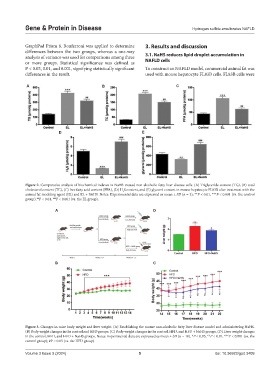
            P < 0.05, 0.01, and 0.001, signifying statistically significant   To construct an NAFLD model, commercial animal fat was
            differences in the result.                         used with mouse hepatocyte FL83B cells. FL83B cells were

            A                               B                               C


                          D                                  E


            Figure 2. Comparative analysis of biochemical indexes in NaHS-treated non-alcoholic fatty liver disease cells. (A) Triglyceride content (TG), (B) total
            cholesterol content (TC), (C) free fatty acid content (FFA), (D) H S content, and (E) glycerol content in mouse hepatocyte FL83B after treatment with the
                                                     2
            animal fat modeling agent (EL) and EL + NaHS. Notes: Experimental data are expressed as mean ± SD (n = 3); **P < 0.01, ***P < 0.001 (vs. the control
                        ###
            group); P < 0.01,  P < 0.001 (vs. the EL group).
                  ##
                         A                                        D


                        B                                         C


            Figure 3. Changes in mice body weight and liver weight. (A) Establishing the mouse non-alcoholic fatty liver disease model and administering NaHS.
            (B) Body weight changes in the control and HFD groups. (C) Body weight changes in the control, HFD, and HFD + NaHS groups. (D) Liver weight changes
            in the control, HFD, and HFD + NaHS groups. Notes: Experimental data are expressed as mean ± SD (n = 10). *P < 0.05, **P < 0.01, ***P < 0.001 (vs. the
            control group); #P < 0.05 (vs. the HFD group).

            Volume 3 Issue 3 (2024)                         5                               doi: 10.36922/gpd.3409

