


Page 124 - GPD-3-3
P. 124
Gene & Protein in Disease                                              Hydrogen sulfide ameliorates NAFLD


                         A


                         B                                     C


                         D                                     E


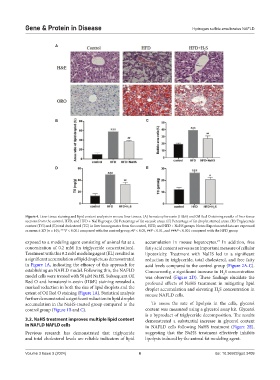
            Figure 4. Liver tissue staining and lipid content analysis in mouse liver tissues. (A) hematoxylin-eosin (H&E) and Oil Red O staining results of liver tissue
            sections from the control, HFD, and HFD + NaHS groups. (B) Percentage of fat vacuole areas. (C) Percentage of fat droplet stained areas. (D) Triglyceride
            content (TG) and (E) total cholesterol (TC) in liver homogenates from the control, HFD, and HFD + NaHS groups. Notes: Experimental data are expressed
            as mean ± SD (n = 10); ***P < 0.001 compared with the control group; #P < 0.05, ##P < 0.01, and ###P < 0.001 compared with the HFD group.

            exposed to a modeling agent consisting of animal fat at a   accumulation in mouse hepatocytes.  In addition, free
                                                                                             47
            concentration  of 0.2 mM  (in triglyceride concentration).   fatty acid content serves as an important measure of cellular
            Treatment with this 0.2 mM modeling agent (EL) resulted in   lipotoxicity. Treatment with NaHS led to a significant
            a significant accumulation of lipid droplets, as demonstrated   reduction in triglyceride, total cholesterol, and free fatty
            in Figure 1A, indicating the efficacy of this approach for   acid levels compared to the control group (Figure 2A-C).
            establishing an NAFLD model. Following this, the NAFLD   Concurrently, a significant increase in H S concentration
                                                                                                2
            model cells were treated with 50 μM NaHS. Subsequent Oil   was  observed  (Figure  2D).  These  findings  elucidate  the
            Red O and hematoxylin-eosin (H&E) staining revealed a   profound effects of NaHS treatment in mitigating lipid
            marked reduction in both the size of lipid droplets and the   droplet accumulation and elevating H S concentration in
            extent of Oil Red O staining (Figure 1A). Statistical analysis   mouse NAFLD cells.  2
            further demonstrated a significant reduction in lipid droplet
            accumulation in the NaHS-treated group compared to the   To assess the rate of lipolysis in the cells, glycerol
            control group (Figure 1B and C).                   content was measured using a glycerol assay kit. Glycerol
                                                               is a byproduct of triglyceride decomposition. The results
            3.2. NaHS treatment improves multiple lipid content   demonstrated a substantial increase in glycerol content
            in NAFLD NAFLD cells                               in NAFLD cells following NaHS treatment (Figure  2E),
            Previous research has demonstrated that triglyceride   suggesting that  the NaHS  treatment effectively  inhibits
            and total cholesterol levels are reliable indicators of lipid   lipolysis induced by the animal fat modeling agent.


            Volume 3 Issue 3 (2024)                         6                               doi: 10.36922/gpd.3409

