


Page 135 - GPD-3-3
P. 135
Gene & Protein in Disease                                              Association of GST1 with lung cancer


            lung cancer and healthy smoker controls. However,    Our analysis revealed a discernible trend associating
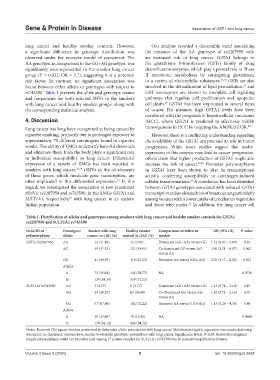
            a  significant  difference  in  genotype  distribution was   the presence of the AA genotype of rs2207950 with
            observed under the recessive model of assessment. The   an  increased  risk  of  lung  cancer.  GSTA1  belongs  to
            AA genotype, in comparison to the GG+AG genotype, was   the  glutathione  S-transferases (GSTs)  family  of drug
            significantly over-represented in the smoker lung cancer   detoxification enzymes, which play a pivotal role in Phase
            group (P = 0.022; OR = 2.7), suggesting it is a potential   II xenobiotic metabolism by conjugating glutathione
            risk factor. In contrast, no significant association was   to a variety of electrophilic substances. 25,26  GSTs are also
                                                                                                         27
            found between either alleles or genotypes with respect to   involved in the detoxification of lipid peroxidation,  and
            rs743590. Table 1 presents the allele and genotype counts   GST isoenzymes are known to modulate cell signaling
            and frequencies for both selected SNVs in the smokers   pathways  that  regulate  cell proliferation and  apoptotic
                                                                       27
            with lung cancer and healthy smoker groups, along with   cell death.  GSTA1 has been implicated in several types
            the corresponding statistical analysis.            of cancer. For instance, high GSTA1 levels have been
                                                               correlated with the prognosis of hepatocellular carcinoma
            4. Discussion                                      (HCC), where GSTA1 is predicted to effectively inhibit
            Lung cancer has long been recognized as being caused by   tumorigenesis in HCC by targeting the AMPK/mTOR. 28
            cigarette smoking, primarily due to prolonged exposure to   However, there is a conflicting understanding regarding
            approximately 70 different carcinogens found in cigarette   the availability of the GSTA1 enzyme and its role in tumor
            smoke. The ability of XMGs to detoxify harmful chemicals   progression. While some studies suggest that under-
            and eliminate them from the body plays a significant role   expression of this enzyme may lead to cancer progression,
            in individual susceptibility to lung cancer. Differential   others claim that higher production of GSTA1 might also
            expression of a variety  of XMGs has been reported in   increase the risk of cancer. 29,30  Promoter polymorphisms
            smokers  with  lung  cancer. 22,23   rSNVs  in  the  cis-elements   in  GSTA1 have been shown to alter its transcriptional
            of these genes, which modulate gene transcription, are   activity, conferring susceptibility to carcinogen-induced
            often implicated in this differential expression.  In this   cellular transformations.  A correlation has been identified
                                                                                  31
                                                   24
            regard, we investigated the association of two prioritized   between GSTA1 genotypes associated with reduced GSTA1
            rSNVs: rs2207950 and rs743590, in the XMGs GSTA1 and   transcription and an elevated risk of breast cancer, particularly
            SULT1A1, respectively,  with lung cancer in an eastern   among women with a lower intake of cruciferous vegetables
                              17
            Indian population.                                 and those who smoke.  In addition, the lung cancer cell
                                                                                 32
            Table 1. Distribution of alleles and genotypes among smokers with lung cancer and healthy smoker controls for GSTA1
            rs2207950 and SULT1A1 rs743590

            Gene/ID of      Genotypes/  Smoker with lung   Healthy smoker   Comparisons of different   OR (95% CI)  P‑value
            polymorphism    alleles   cancer (n=101) (%)  control (n=252) (%)  models
            GSTA1/rs2207950  AA                12 (11.88)           12 (4.76)  Dominant (AG+AA) versus GG  1.31 (0.82 – 2.09)  0.26
                            AG                 48 (47.52)           121 (48.01)  Co-dominant GG versus AG   2.90 (1.21 – 6.97)  0.062
                                                                    versus AA
                            GG                 41 (40.59)           119 (47.22)  Recessive AA versus (GG+AG)  2.70 (1.17 – 6.22)  0.022
                            Alleles
                             A                 72 (35.64)           145 (28.77)  NA                     0.0736
                             G           130 (64.36)           359 (71.23)
            SULT1A1/rs743590  AA               3 (3.57)           8 (3.17)  Dominant (AG+AA) versus GG  1.23 (0.71 – 2.10)  0.45
                             AG                24 (28.57)           62 (24.60)  Co-Dominant GG versus AG   1.20 (0.71 – 2.16)  0.75
                                                                    versus AA
                             GG                57 (67.86)           182 (72.22)  Recessive AA versus (GG+AG)  1.13 (0.29 – 4.36)  0.86
                            Alleles
                             A                 30 (17.86)           78 (15.48)  NA                      0.4668
                             G           138 (82.14)    426 (84.52)
            Notes: Pearson’s Chi-square test was performed to determine allelic associations with lung cancer. Multivariate logistic regression was conducted using
            dominant, co-dominant, and recessive models to establish genotypic associations with lung cancer. Significance levels: P<0.05. Restriction fragment
            length polymorphism could not be performed among 17 patient samples for SULT1A1 rs743590 due to repeated amplification failures.


            Volume 3 Issue 3 (2024)                         5                               doi: 10.36922/gpd.3928

