


Page 42 - GPD-3-3
P. 42
Gene & Protein in Disease                                         Phage therapy for Mycobacterium infections


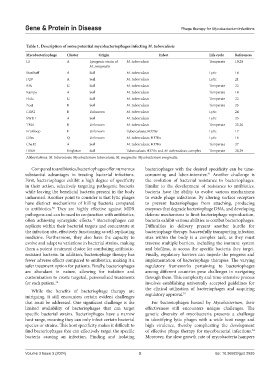
            Table 1. Description of some potential mycobacteriophages infecting M. tuberculosis
            Mycobacteriophage  Cluster     Origin                    Infect               Life cycle  References
            L5               A         Lysogenic strain of   M. tuberculosis              Temperate  19,20
                                       M. smegmatis
            StarStuff        A         Soil            M. tuberculosis                    Lytic      14
            D29              A         Soil            M. tuberculosis                    Lytic      21
            BPs              G         Soil            M. tuberculosis                    Temperate  22
            Kampy            A         Soil            M. tuberculosis                    Temperate  14
            Halo             G         Soil            M. tuberculosis                    Temperate  22
            ZoeJ             K         Soil            M. tuberculosis                    Temperate  23
            CRB2             B         Unknown         M. tuberculosis                    Lytic      24
            SWU1             A         Soil            M. tuberculosis                    Lytic      25
            TM4              K         Unknown         M. tuberculosis                    Temperate  23,26
            Fruitloop        F         Unknown         Tuberculosis; H37Rv                Lytic      17
            Giles            Q         Unknown         M. tuberculosis; H37Rv             Lytic      16
            Che12            A         Soil            M. tuberculosis; H37Rv             Temperate  27
            DS6A             Singleton  Soil           Tuberculosis H37Rv and M. tuberculosis; complex  Temperate  28,29
            Abbreviations: M. tuberculosis: Mycobacterium tuberculosis; M. smegmatis: Mycobacterium smegmatis.

              Compared to antibiotics, bacteriophages offer numerous   bacteriophages  with  the  desired  specificity  can  be  time-
            substantial advantages in treating bacterial infections.   consuming  and  labor-intensive.   Another  challenge  is
                                                                                         31
            First,  bacteriophages  exhibit  a  high  degree  of  specificity   the evolution of bacterial resistance to bacteriophages.
            in their  action, selectively targeting pathogenic bacteria   Similar to the development of resistance to antibiotics,
            while leaving the beneficial bacteria present in the body   bacteria have the ability to evolve various mechanisms
            unharmed. Another point to consider is that lytic phages   to evade phage infections. By altering surface receptors
            have distinct mechanisms of killing bacteria compared   to prevent bacteriophages from attaching, producing
            to antibiotics.  They are highly effective against MDR   enzymes that degrade bacteriophage DNA, and developing
                       30
            pathogens and can be used in conjunction with antibiotics,   defense mechanisms to limit bacteriophage reproduction,
            often achieving synergistic effects.  Bacteriophages can   bacteria exhibit various abilities to combat bacteriophages.
                                        31
            replicate within their bacterial targets and concentrate at   Difficulties in delivery present another hurdle for
            the infection site, effectively functioning as self-replicating   bacteriophage therapy. Successfully transporting infection
            medicine. Furthermore, they also have the capacity to   sites within the body is a complex task, as they must
            evolve and adapt to variations in bacterial strains, making   traverse multiple barriers, including the immune system
            them a potent treatment choice for combating antibiotic-  and biofilms, to access the specific bacteria they target.
            resistant bacteria. In addition, bacteriophage therapy has   Finally, regulatory barriers can impede the progress and
            fewer adverse effects compared to antibiotics, making it a   implementation of bacteriophage therapies. The varying
            safer treatment option for patients. Finally, bacteriophages   regulatory frameworks  pertaining to bacteriophages
            are abundant in nature, allowing for isolation and   among different countries pose challenges in navigating
            customization to create targeted, personalized treatments   through them. This complexity and time-intensive process
            for each patient. 32                               involves establishing universally accepted guidelines for
              While the benefits of bacteriophage therapy are   the clinical utilization of bacteriophages and acquiring
            intriguing, it  still encounters certain evident challenges   regulatory approval. 33
            that must be addressed. One significant challenge is the   For bacteriophages hosted by  Mycobacterium, their
            limited availability of bacteriophages that can target   effectiveness  still  encounters  unique  challenges.  The
            specific bacterial strains. Bacteriophages have a narrow   genetic diversity of mycobacteria presents a challenge
            host range, meaning they can only infect certain bacterial   in  identifying  lytic  phages  with  a  wide  host  range  and
            species or strains. This host specificity makes it difficult to   high virulence, thereby complicating the development
            find bacteriophages that can effectively target the specific   of effective phage therapy for mycobacterial infections.
                                                                                                            34
            bacteria causing an  infection.  Finding  and isolating   Moreover, the slow growth rate of mycobacteria hampers


            Volume 3 Issue 3 (2024)                         3                               doi: 10.36922/gpd.2935

