


Page 47 - GPD-3-3
P. 47
Gene & Protein in Disease                                         Phage therapy for Mycobacterium infections


            guinea pigs. The bacteriophage D29 has demonstrated the   there are about 10  phage infections per second, with new
                                                                             23
            capability to infect M. tuberculosis and has been effectively   generations emerging every few days. Given these data, it is
            utilized in the diagnosis and treatment of TB. 88,89  In   not surprising that phage populations are highly diverse. 40
            general, mycobacteriophages offer potential as tools to   Mycobacteriophages are viruses that infect mycobacterial
            address drug-resistant TB, but further investigation and   hosts and are of particular interest for two primary reasons.
            advancement are necessary to fully realize their clinical   First,  the  abundance  of  complete  mycobacteriophage
            potential. Despite persistent challenges in treating drug-
            resistant TB, phage therapy, as an innovative therapeutic   genome sequences suggests a high level of diversity,
            approach, presents a ray of hope in addressing the issue of   offering valuable insights into phage genomic diversity
            drug resistance in M. tuberculosis. With continued research   and  the  evolutionary  mechanisms  responsible  for  this
                                                                      42
            and practical application, phage therapy is anticipated   diversity.   Second,  mycobacteriophages  offer  a rich  array
            to emerge as an efficacious method for addressing TB   of tools for developing genetic systems for hosts, including
            and other drug-resistant infections, thereby making a   M. tuberculosis, the pathogen responsible for human TB,
            significant contribution to the global  prevention  and   and present novel strategies for diagnosing, preventing,
            treatment of TB.                                   and treating TB. Furthermore, the discovery and genomic
                                                               characterization of new mycobacteriophages provide
              Nowadays, mycobacteriophage therapy alone/in     an effective platform for introducing authentic research
            cocktails  or in combination with antibiotics has opened   experiences to inexperienced scientists. 100
                   90
            up new horizons for the treatment of infections caused
            by pathogenic mycobacteria 91-93  (Table 2). Furthermore,   Phage  therapy  is  a  treatment  modality  that  employs
            engineered shuttle plasmids have been employed for   specific phage viruses to target and eliminate bacteria.
            diagnostic purposes in the context of mycobacteriophage   Depending on how phages are used, phage therapy can be
            infection of  M. tuberculosis strains. Notably, DS6A and   divided into several types. One approach involves using
            TM4 have been utilized in various investigations to   individual phages, which may have limitations due to
            produce shuttle plasmids. 26                       their narrow host spectrum and potential for inadequate
                                                               immune response. Another approach is phage cocktail
            7. Discussion                                      therapy, where a combination of multiple phages is used
            Bacteriophages are a type of virus that infects and causes   to address bacterial infections, with the objective of
            the lysis of bacteria, exhibiting their ability to selectively   leveraging diverse phages to augment therapeutic efficacy,
            target and eliminate their host bacteria. They are prevalent   particularly against MDR strains. The process of preparing
            both in natural environments and within the human   a phage cocktail entails screening and isolating numerous
            body. Essentially, wherever bacteria exist, bacteriophages   phages from the environment and then combining them
            are also present.  The estimated number of phages in the   to create a therapeutic mixture. Each phage exhibits
                         97
            biosphere is approximately 10 31,97-99  Originating around   specificity  and  can  be  directed  against  distinct  bacterial
            3 billion years ago, phage populations are dynamic and   strains.  Utilizing  multiple  phages  concurrently  enables
            continually evolving. They persistently infect host bacteria,   the provision of wider protection against diverse bacterial
            replicate, and replenish their numbers. It is estimated that   types. The advantage of this approach is that it prevents

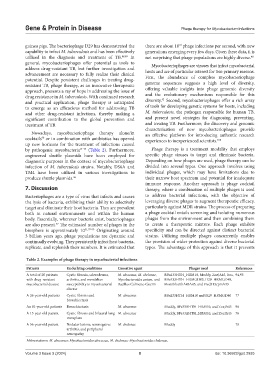
            Table 2. Examples of phage therapy in mycobacterial infections
            Patients         Underlying conditions  Causative agent              Phages used         References
            A total of 20 patients   Cystic fibrosis, scleroderma,   M. abscessus, M. chelonae,   BPs∆33HTH_HRM10, Muddy, ZoeJ∆45, Itos,  94,95
            with drug-resistant   arthritis, and mendelian   Mycobacteroides avium, and   BPs∆33HTH_HRMGD03, D29_HRMGD40,
            mycobacterial disease  susceptibility to mycobacterial   Bacillus Calmette-Guerin  Fionnbharth∆43∆45, and Fred313cpm∆33
                             disease
            A 26-year-old patients  Cystic fibrosis and   M. abscessus  BPsΔ33HTH_HRM10 and D29_HRMGD40  77
                             bronchiectasis
            An 81-year-old patients  Bronchiectasis  M. abscessus      Muddy, BPs33ΔHTH_HRM10, and ZoeJΔ45  96
            A 15-year-old patient  Cystic fibrosis and bilateral lung  M. abscessus  Muddy, BPs33ΔHTH_HRM10, and ZoeJΔ45  76
                             transplant
            A 56-year-old patient  Nodular lesions, seronegative   M. chelonae  Muddy                78
                             arthritis, and peripheral
                             neuropathy
            Abbreviations: M. abscessus: Mycobacteroides abscessus, M. chelonae: Mycobacteroides chelonae.

            Volume 3 Issue 3 (2024)                         8                               doi: 10.36922/gpd.2935

