


Page 44 - GPD-3-3
P. 44
Gene & Protein in Disease                                         Phage therapy for Mycobacterium infections


            classification systems are still evolving, and new clusters   5.2. Nucleoid-associated protein-Lsr2
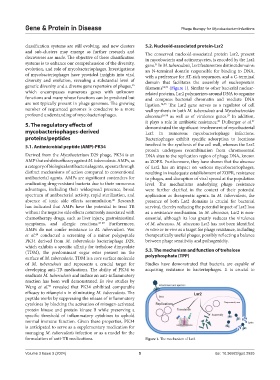
            and sub-clusters may emerge as further research and   The conserved nucleoid-associated protein Lsr2, present
            discoveries are made. The objective of these classification   in mycobacteria and actinomycetes, is encoded by the Lsr2
            systems is to enhance our comprehension of the diversity,   gene.  In M. tuberculosis, Lsr2 features two distinct domains:
                                                                   51
            evolution, and role of mycobacteriophages. Investigations   an N-terminal domain responsible for binding to DNA,
            of mycobacteriophages have provided insights into viral   with a preference for AT-rich sequences, and a C-terminal
            diversity and evolution, revealing a substantial level of   domain that  facilitates  the assembly  of nucleoprotein
            genetic diversity and a diverse gene repertoire of phages,    filaments 52,53  (Figure 1). Similar to other bacterial nuclear-
                                                         45
            which encompasses numerous genes with unknown      related proteins, Lsr2 polymerizes around DNA to organize
            functions and many whose functions can be predicted but   and compress bacterial chromatin and mediate  DNA
            are not typically present in phage genomes. The growing   ligation. 54,55  The Lsr2 gene serves as a regulator of cell
            number of sequenced genomes is conducive to a more   wall synthesis in both M. tuberculosis and Mycobacteroides
            profound understanding of mycobacteriophages.      abscessus 56-58   as well as  of  virulence  genes.   In  addition,
                                                                                                  59
                                                               it plays a role in antibiotic resistance.  Dulberger et al.
                                                                                              60
                                                                                                            61
            5. The regulatory effects of                       demonstrated the significant involvement of mycobacterial
            mycobacteriophages-derived                         Lsr2 in numerous mycobacteriophage infections.
            proteins/peptides                                  Bacteriophages exhibit specific adsorption to locations
            5.1. Antimicrobial peptide (AMP)-PK34              involved in the synthesis of the cell wall, whereas the Lsr2
                                                               protein undergoes recombination from chromosomal
            Derived from the Mycobacterium D29 phage, PK34 is an   DNA sites to the replication region of phage DNA, known
            AMP that exhibits efficacy against M. tuberculosis. AMPs, as   as ZOPR. Furthermore, they have shown that the absence
            a category of biological antibacterial agents, operate through   of Lsr2 has an impact  on various mycobacteriophages,
            distinct mechanisms of action compared to conventional   resulting in inadequate establishment of ZOPR, resistance
            antibacterial agents. AMPs are significant contenders for   to phages, and disruption of viral spread at the population
            eradicating drug-resistant bacteria due to their numerous   level. The mechanisms underlying phage resistance
            advantages, including their widespread presence, broad   were further clarified in the context of their potential
            spectrum of antibacterial activity, rapid sterilization, and   application as therapeutic agents. In M. tuberculosis, the
            absence of toxic side effects accumulation.  Research   presence of both Lsr2 domains is crucial for bacterial
                                                 46
            has indicated that AMPs have the potential to treat TB   survival, thereby reducing the potential impact of Lsr2 loss
            without the negative side effects commonly associated with   as a resistance mechanism. In M. abscessus, Lsr2 is non-
            chemotherapy drugs, such as liver injury, gastrointestinal   essential, although its loss greatly reduces the virulence
            symptoms, and allergic reactions. 47-49  Furthermore,   of M. abscessus. M. abscessus Lsr2 has not been identified
            AMPs do not confer resistance to  M.  tuberculosis. Wei   in vitro or in vivo as a target for phage resistance, including
            et  al.  conducted a screening of a minor polypeptide   therapeutically useful phages, possibly reflecting a balance
                48
            PK34 derived from  M. tuberculosis bacteriophage D29,   between phage sensitivity and pathogenicity.
            which exhibits a specific affinity for trehalose dimycolate
            (TDM), the predominant sugar ester present on the   5.3. The mechanism and function of trehalose
            surface of M. tuberculosis. TDM is a core surface molecule   polyphosphate (TPP)
            of  M.  tuberculosis and represents a crucial target for   Studies  have  demonstrated  that  bacteria  are  capable  of
            developing anti-TB medications. The ability of PK34 to   acquiring resistance to bacteriophages. It is crucial to
            eradicate M. tuberculosis and induce an anti-inflammatory
            reaction has been well demonstrated.  In vivo studies by
            Wang  et al.  revealed that PK34 exhibited comparable
                      50
            efficacy to rifampicin in eliminating M. tuberculosis. The
            peptide works by suppressing the release of inflammatory
            cytokines by blocking the activation of mitogen-activated
            protein kinase and protein kinase B while preserving a
            specific threshold of inflammatory cytokines to uphold
            normal immune function. Given these properties, PK34
            is anticipated to serve as a supplementary medication for
            managing M. tuberculosis infection or as a model for the
            formulation of anti-TB medications.                Figure 1. The mechanism of Lsr2


            Volume 3 Issue 3 (2024)                         5                               doi: 10.36922/gpd.2935

