


Page 79 - GTM-1-2
P. 79
Global Translational Medicine                                               Succinate metabolism in CVD


            resulted in the expansion of Th17 cells, which, further, led
            to autoimmune diseases .
                               [34]
              In addition to its effect on chemotaxis, SUCNR1 also
            plays an important role in macrophage inflammation.
            However, there are conflicting results in the current
            research. SUCNR1 plays a pro-inflammatory role in M2
            macrophages derived from human peripheral blood
            monocytes.  IL-4  or  IL-10  stimulates  macrophages,
            resulting  in  the  upregulation  of  SUCNR1  expression  in
            macrophages. However, the treatment of macrophages
            with succinate or SUCNR1 agonists decreases the secretion
            of IL-10 and increases TNF-α expression in macrophages,
            thus  enhancing  the   inflammatory  response .
                                                        [35]
            Macrophages are activated by inflammatory signals
            release succinate to the extracellular environment, activate
            SUCNR1 through autocrine and paracrine signaling, and
            promote the production of IL-1β, thus further aggravating
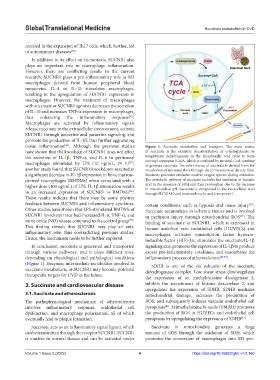
            tissue inflammation . Although the previous studies   Figure  1. Succinate metabolism and transport. The main source
                            [36]
            have shown that the knockout of SUCNR1 does not affect   of succinate is the oxidative decarboxylation of  α-ketoglutarate by
            the secretion of IL-1β, TNF-α, and IL-6 in peritoneal   oxoglutarate dehydrogenase in the tricarboxylic acid cycle to form
                                                        [37]
            macrophages stimulated by LPS (10  ng/mL, 24  h) ,   succinyl-coenzyme (Co)A, which is catalyzed by succinyl-CoA synthase
                                                               to generate succinate. The other source of succinate is derived from the
            another study found that SUCNR1 knockdown resulted in   metabolism of intestinal flora through the fermentation of dietary fiber.
            a significant decrease in IL-1β expression in bone marrow-  Succinate generates excessive reactive oxygen species during oxidation.
            derived macrophages (BMDMs) when stimulated with a   The metabolic pathway of succinate includes the oxidation to fumaric
            higher dose (100 ng/mL) of LPS. IL-1β stimulation results   acid in the presence of SDH and then protonation due to the decrease
                                                               in mitochondrial pH. Succinate is transported to the extracellular level
                                                        [36]
            in an increased expression of SUCNR1 in BMDMs .    through SLC25A10 and monocarboxylic acid transporter 1.
            These results indicate that there may be some positive
            feedback between SUCNR1 and inflammatory cytokines.   certain conditions, such as hypoxia and tissue injury .
                                                                                                           [39]
            Other studies have shown that LPS-stimulated BMDMs of   Succinate accumulates in ischemic tissues and is involved
            SUCNR1 knockout mice had increased IL-6, TNF-α, and   in perfusion injury through mitochondrial ROS . The
                                                                                                       [24]
            nitric oxide (NO) release compared to the control group .   binding of succinate to SUCNR1, which is expressed in
                                                        [38]
            This  finding  reveals  that  SUCNR1  may  play  an  anti-  human umbilical vein endothelial cells (HUVECs) and
            inflammatory role, thus contradicting previous studies.   macrophages, activates transcription factor hypoxia-
            Hence, the mechanism needs to be further explored.  inducible factor (HIF)-1α, stimulates the succinate/IL-1β
              In conclusion, succinate is generated and transported   signaling axis, promotes the expression of IL-1β to produce
            through  various  pathways,  and  it  plays  different  roles,   excess pro-inflammatory cytokines, and exacerbates the
            depending on physiological and pathological conditions   inflammatory process of atherosclerosis [23,40] .
            (Figure 1). Enzymes, intermediate metabolites involved in   SDHB is one of the six subunits of the succinate
            succinate metabolism, or SUCNR1 may become potential   dehydrogenase complex. Low shear stress downregulates
            therapeutic targets for CVD in the future.
                                                               the expression of tet methylcytosine dioxygenase 2,
            3. Succinate and cardiovascular disease            inhibits the recruitment of histone deacetylase 2, and
                                                               upregulates the expression of SDHB. SDHB mediates
            3.1. Succinate and atherosclerosis                 mitochondrial damage, increases the production of
            The pathophysiological mechanism of atherosclerosis   ROS, and subsequently induces vascular endothelial cell
            involves  inflammatory  response,  endothelial  cell  pyroptosis . Trimethylamine N-oxide (TMAO) promotes
                                                                       [41]
            dysfunction, and macrophage polarization, all of which   the production of ROS in HUVECs and endothelial cell
            eventually lead to plaque formation.               pyroptosis by upregulating the expression of SDHB .
                                                                                                        [42]
              Succinate acts as an inflammatory signal ligand, which   Succinate in mitochondria generates a large
            can be transmitted through the receptor SUCNR1. SUCNR1   amount of ROS through the oxidation of SDH, which
            is inactive in normal tissues and can be activated under   promotes the conversion of macrophages into M1 pro-


            Volume 1 Issue 2 (2022)                         4                      https://doi.org/10.36922/gtm.v1i2.160

