


Page 82 - GTM-1-2
P. 82
Global Translational Medicine                                               Succinate metabolism in CVD


            and prevent obesity as well as metabolic dysfunction
            caused by HFD in newborn mice . It is associated with
                                       [73]
            enhanced succinylation and H3K4me3 modification in the
            PPARGC1A promoter. These results suggest that succinate
            can promote energy consumption and counter obesity by
            activating thermogenic fat, and this effect can be passed on
            to offspring.

              Succinate can increase the differentiation of beige
            adipocytes. Stearoyl COA desaturase 1 (SCD1) is a rate-
            limiting enzyme of monounsaturated fatty acids. SCD1
            induces the differentiation of preadipocytes into beige
            adipocytes through mitochondrial complex II activity
            that is driven by succinate . Succinate inhibits the
                                    [74]
            decomposition of triglycerides in white fat through
            SUCNR1 . The mitochondrial dicarboxylate vector
                   [75]
            SLC25A10 is mainly expressed in white adipose tissue
            (WAT), which enhances mitochondrial respiration,
            promotes succinate transport to the outside of cells, and
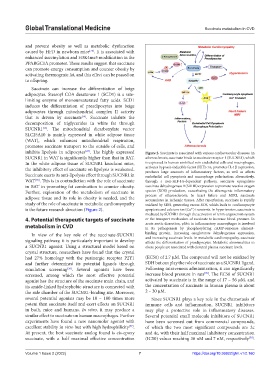
            inhibits lipolysis in adipocytes . The highly expressed   Figure 2. Succinate is associated with various cardiovascular diseases. In
                                     [27]
            SUCNR1 in WAT is significantly higher than that in BAT.   atherosclerosis, succinate binds to succinate receptor 1 (SUCNR1), which
            In the white adipose tissue of SUCNR1 knockout mice,   is expressed in human umbilical vein endothelial cells and macrophages,
            the inhibitory effect of succinate on lipolysis is weakened.   activates hypoxia-inducible factor (HIF)-1α, promotes IL-1β expression,
                                                               produces large amounts of inflammatory factors, as well as affects
            Succinate exerts its anti-lipolysis effect through SUCNR1 in   endothelial cell pyroptosis and macrophage polarization; alternatively,
            WAT . This is in contradiction with the role of succinate   through a non-HIF-1α-dependent pathway, succinate upregulates
                [76]
            in BAT in promoting fat combustion to counter obesity.   succinate dehydrogenase B (SDHB) expression to promote reactive oxygen
            Further, exploration of the metabolism of succinate in   species (ROS) production, exacerbating the atherogenic inflammatory
            adipose tissue and its role in obesity is needed, and the   process of atherosclerosis. In heart failure and MIRI, succinate
                                                               accumulates in ischemic tissues. After reperfusion, succinate is rapidly
            study of the role of succinate in metabolic cardiomyopathy   oxidized by SDH, generating excess ROS, which leads to cardiomyocyte
            is the future research direction (Figure 2).       apoptosis and calcium ion (Ca ) transients. In hypertension, succinate is
                                                                                  2+
                                                               mediated by SUCNR1 through the activation of renin-angiotensin system
            4. Potential therapeutic targets of succinate      or the transport mechanism of succinate to increase blood pressure. In
            metabolism in CVD                                  acute aortic dissection, p38α in inflammatory macrophages is involved
                                                               in its pathogenesis by phosphorylating cAMP-response element-
              In view of the key role of the succinate-SUCNR1   binding protein, increasing oxoglutarate dehydrogenase expression,
            signaling pathway, it is particularly important to develop   and increasing succinate levels. In metabolic cardiomyopathy, succinate
                                                               affects the differentiation of preadipocytes. Metabolic abnormalities in
            a SUCNR1 agonist. Using a structural model based on   obese people are associated with elevated plasma succinate levels.
            crystal structure, researchers have found that the crystal
            had 27% homology with the purinergic receptor P2Y1   (EC50) of 2.7 μM. The compound will not be oxidized by
            and further determined its potential ligands through   SDH but can play the role of succinate as a SUCNR1 ligand.
            simulation screening . Several agonists have been   Following intravenous administration, it can significantly
                              [36]
                                                                                        [78]
            screened, among which the most effective potential   increase blood pressure in rats . The EC50 of SUCNR1
            agonist has the structure of the succinate main chain, and   activated by succinate is in the range of 17 – 56 μM, and
            its amide-linked hydrophobic structure is connected with   the concentration of succinate in human plasma is about
            the side chamber of the SUCNR1-binding site. Moreover,   2 – 30 μM.
            several potential agonists may be 10 – 100  times more   Since SUCNR1 plays a key role in the chemotaxis of
            potent than succinate itself and exert effects on SUCNR1   immune  cells  and  inflammation,  SUCNR1  inhibitors
            in both, mice and humans.  In vitro, it may produce a   may play a protective role in inflammatory diseases.
            similar effect to succinate on human macrophages. Further   Several potential small molecule inhibitors of SUCNR1
            experiments have found a new nanomolar agonist with   have been screened out from commercial compounds,
            excellent stability in vitro but with high hydrophilicity .   of which the two most significant compounds are 2c
                                                        [77]
            At  present,  the  best  succinate  analog  found  is  cis-epoxy   and 4c, with their half maximal inhibitory concentration
            succinate, with a half maximal effective concentration   (IC50) values reaching 30 nM and 7 nM, respectively .
                                                                                                           [79]

            Volume 1 Issue 2 (2022)                         7                      https://doi.org/10.36922/gtm.v1i2.160

