


Page 83 - GTM-1-2
P. 83
Global Translational Medicine                                               Succinate metabolism in CVD


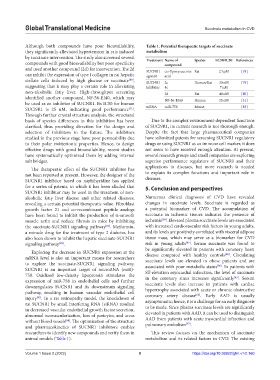
            Although both compounds have poor bioavailability,   Table 1. Potential therapeutic targets of succinate
            they significantly alleviated hypertension in rats induced   metabolism
            by succinate intervention. The study also screened several   Treatment  Name of   Species  EC50/IC50 References
            compounds with good bioavailability but poor specificity   compound
            and used another compound (2d) for intervention. The 2d   SUCNR1  cis-Epoxysuccinic  Rat  2.7 μM  [78]
            can inhibit the expression of type I collagen in rat hepatic   agonist  acid
            stellate cells induced by high glucose or succinate ,   SUCNR1  2c      Human/Rat  30 nM    [79]
                                                        [80]
            suggesting that it may play a certain role in alleviating   inhibitor  4c          7 nM
            non-alcoholic fatty liver. High-throughput screening       2d           Rat       40 nM     [80]
            identified another compound, NF-56-EJ40, which may         NF-56-EJ40   Human     25 nM     [31]
            be used as an inhibitor of SUCNR1. Its IC50 for human
                                                        [31]
            SUCNR1 is 25 nM, indicating good performance .     mRNA    miR-758      Mouse               [83]
            Through further crystal structure analysis, the structural
            basis of species differences in this inhibition has been   Due to the complex environment-dependent functions
            clarified,  thus  providing  direction  for  the  design  and   of SUCNR1, its current research is not thorough enough.
            selection of inhibitors in the future. The inhibitors   Despite the fact that large pharmaceutical companies
            studied in the previous stage have poor permeability due   have submitted patents for screening SUCNR1 regulatory
            to their polar zwitterionic properties. Hence, to design   drugs or using SUCNR1 as an immune cell marker, it does
            effective drugs with good bioavailability, recent studies   not seem to have received enough attention. At present,
            have systematically optimized them by adding internal   several research groups and small companies are exploring
            salt bridges.                                      superior performance regulators of SUCNR1 and their
              The  therapeutic  effect  of  the  SUCNR1  inhibitor  has   applications in diseases, but more research is needed
            not been reported at present. However, the designer of the   to explain its complex functions and important role in
            SUCNR1 inhibitor based on naphthyridine has applied   diseases.
            for a series of patents, in which it has been alluded that   5. Conclusion and perspectives
            SUCNR1 inhibitor may be used in the treatment of non-
            alcoholic fatty liver disease and other related diseases,   Numerous clinical diagnoses of CVD have revealed
            revealing a certain potential therapeutic value. Fibroblast   changes in succinate levels. Succinate is regarded as
            growth factor 21 and co-recombinant peptide analogs   a potential biomarker of CVD. The accumulation of
            have been found to inhibit the production of  α-smooth   succinate in ischemic  tissues indicates the presence of
                                                                      [24]
            muscle actin and reduce fibrosis in mice by inhibiting   ischemia . Elevated plasma succinate levels are associated
            the succinate-SUCNR1 signaling pathway . Metformin,   with increased cardiovascular risk factors in young adults,
                                              [81]
            a miracle drug for the treatment of type 2 diabetes, has   and its levels are positively correlated with visceral adipose
            also been shown to inhibit the hepatic succinate-SUCNR1   tissue mass, which may serve as a biomarker for CVD
            signaling pathway .                                risk in young adults . Serum succinate was found to
                                                                                [85]
                          [82]
                                                               be significantly elevated in patients with coronary heart
              Exploring the decrease in SUCNR1 expression at the                                 [40]
            mRNA  level  is  also  an important  means  for researchers   disease compared with healthy controls . Circulating
            to explore the succinate-SUCNR1 signaling pathway.   succinate levels are elevated in obese patients and are
                                                               associated with poor metabolic status . In patients with
                                                                                             [86]
            SUCNR1 is an important target of microRNA (miR)-   ST-elevation myocardial infarction, the level of succinate
            758. Oxidized low-density lipoprotein stimulates the                                     [43]
            expression of miR-758 in endothelial cells and further   in  the coronary sinus increases significantly . Serum
            downregulates SUCNR1 and its downstream signaling   succinate levels also increase in patients with cardiac
                                                               hypertrophy associated with acute or chronic obstructive
            pathway, resulting in human vascular endothelial cell                   [62]
            injury . In a rat retinopathy model, the knockdown of   coronary artery disease . Early AAD is usually
                 [83]
            rat SUCNR1 by small interfering RNA (siRNA) resulted   asymptomatic; hence, it is a challenge for an early diagnosis
            in decreased vascular endothelial growth factor secretion,   to be made. Since plasma succinate levels are significantly
            abnormal neovascularization, loss of pericytes, and areas   elevated in patients with AAD, it can be used to distinguish
            without blood vessels . The optimization of the structure   AAD from patients with acute myocardial infarction and
                             [84]
                                                                                [47]
            and pharmacokinetics of SUCNR1 inhibitors enables   pulmonary embolism .
            researchers to identify new compounds and verify them in   This review focuses on the mechanism of succinate
            animal models (Table 1).                           metabolism and its related factors in CVD. The existing


            Volume 1 Issue 2 (2022)                         8                      https://doi.org/10.36922/gtm.v1i2.160

