


Page 37 - GTM-2-2
P. 37
Global Translational Medicine                                           Gut microbiota in Onco-Hematology


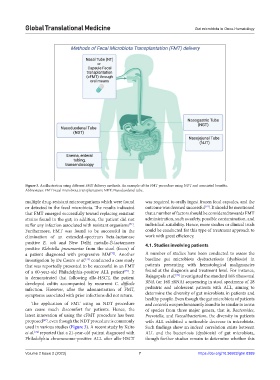
            Figure 3. An illustration using different FMT delivery methods. An example of the FMT procedure using NDT and associated benefits.
            Abbreviates: FMT Fecal microbiota transplantation; NDT: Nasoduodenal tube.

            multiple drug-resistant microorganisms which were found   was required to orally ingest frozen fecal capsules, and the
                                                                                        [74]
            or detected in the fecal microbiota. The results indicated   outcome was deemed successful . It should be mentioned
            that FMT emerged successfully toward replacing resistant   that a number of factors should be considered towards FMT
            strains found in the gut; in addition, the patient did not   administration, such as safety, possible contamination, and
            suffer any infection associated with resistant organisms .   individual suitability. Hence, more studies or clinical trials
                                                        [71]
            Furthermore, FMT was found to be successful in the   could be conducted for this type of treatment approach to
            elimination of an extended-spectrum beta-lactamase   work with great efficiency.
            positive  E.  coli and New  Delhi metallo-β-lactamases   4.1. Studies involving patients
            positive  Klebsiella pneumoniae from the stool (feces) of
            a patient diagnosed with progressive MM . Another   A number of studies have been conducted to assess the
                                                [72]
            investigation by De Castro et al.  conducted a case study   baseline gut microbiota dysbacteriosis (dysbiosis) in
                                     [73]
            that was reportedly presented to be successful in an FMT   patients presenting with hematological malignancies
            of a 60-year-old Philadelphia-positive ALL patient . It   found at the diagnosis and treatment level. For instance,
                                                      [73]
                                                                            [75]
            is demonstrated that following allo-HSCT, the patient   Rajagopala et al.  investigated the standard 16S ribosomal
            developed  colitis  accompanied  by  recurrent  C. difficile   RNA (or 16S rRNA) sequencing in stool specimens of 28
            infection. However, after the administration of FMT,   pediatric and adolescent patients with ALL, aiming to
            symptoms associated with prior infections did not return.  determine the diversity of gut microbiota in patients and
                                                               healthy people. Even though the gut microbiota of patients
              The application of FMT using an NDT procedure    and controls was predominantly found to be similar in terms
            can cause much discomfort for patients. Hence, the   of species from three major genera, that is,  Bacteroides,
            latest innovation of using the cFMT procedure has been   Prevotella, and Faecalibacterium, the diversity in patients
            proposed , even though the NDT procedure is commonly   with ALL exhibited a noticeable decrease in microbiota.
                   [67]
            used in various studies (Figure 3). A recent study by Kaito   Such findings show an indeed correlation exists between
            et al.  reported that a 21-year-old patient diagnosed with   ALL and the bacteriosis (dysbiosis) of gut microbiota,
                [74]
            Philadelphia chromosome-positive ALL after allo-HSCT   though further studies remain to determine whether this

            Volume 2 Issue 2 (2023)                         7                        https://doi.org/10.36922/gtm.0389

