


Page 107 - GTM-2-3
P. 107
Global Translational Medicine                                     TEs link to Parkinson’s risk and progression


            authorization from the Accelerating Medicines Partnership   the PDBP and PPMI cohorts had longitudinal visits with
            in PD (AMP-PD) databases (v2.5 release, https://amp-pd.  several follow-up visits.
            org) upon signing the AMP-PD Data Use Agreement. The
            Institutional Review Board of the School of Medicine, Sun   2.2. TEs discovery and annotation
            Yat-sen University, approved the current analysis.  The WGS CRAM files of 1,931 subjects were generated
              To reduce genetic heterogeneity, participants of   through the alignment of sequencing reads to the human
            Hispanic  or  Latino  heritage  were  excluded,  and  only   reference genome GRCH38DH using the BWA-MEM
                                                                           [37]
                                                                                                        [38]
            subjects from the Caucasian population were included   (version 0.7.15) , following the GATK (version 4.0)  best
                                                                              [39]
            in subsequent analyses. The majority of subjects initially   practices workflow . TEs were called using the Mobile
                                                                                                  [40]
            recruited in the PPMI, PDBP, and BioIFND cohorts had   Element Locator Tool (MELT, version 2.2.2) , which was
            PD, although it is possible that some subjects may have   specifically designed for detecting TEs in Illumina platform-
            received different neurodegenerative disease diagnoses   based  WGS  data.  The  reliability  of  the  MELT  has  been
            during the follow-up period. For the PD cases, we included   validated in projects such as the 1000 Genomes Project
                                                                     [41]
                                                                                               [42]
            only those who were initially diagnosed with PD at baseline   (1KGP)  and the NyuWa Genome Project . Post-discovery
                                                                                                        [43]
            and remained exclusively affected by PD throughout the   QC  was  performed  using  vcftools (version  0.1.16)   and
                                                                                     [44]
            follow-up period. Regarding healthy controls, we included   PLINK (version 1.90b6.22) . In this study, each TE was
            subjects who did not exhibit any neurodegenerative   assigned a unique ID based on its chromosome position
            diseases at both baseline and during the follow-up period.   information and TE type, following the ID format: chr_pos_
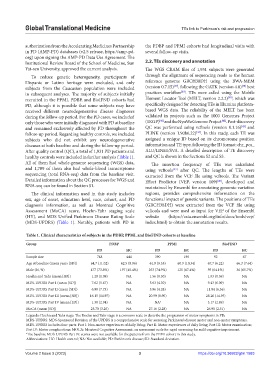
            After quality control (QC), a total of 1,931 PD patients and   ALU/LINE1/SVA. A detailed description of TE discovery
            healthy controls were included in further analysis (Table 1).   and QC is shown in the Sections S2 and S3.
            All of them had whole-genome sequencing (WGS) data,   The insertion  frequency of TEs was  calculated
            and 1,709 of them also had whole-blood transcriptome   using vcftools  after QC. The lengths of TEs were
                                                                           [43]
            sequencing (total RNA-seq) data from the baseline visit.   extracted from the VCF file using vcftools. The Variant
            Detailed information about the QC processes for WGS and   Effect Predictor (VEP, version 109) , developed and
                                                                                             [45]
            RNA-seq can be found in Section S1.                maintained by Ensembl for annotating genomic variation
              The clinical information used in this study includes   regions, provides comprehensive information on the
            sex,  age  of  onset,  education  level,  race,  cohort,  and  PD   functional impact of genetic variants. The positions of TEs
            diagnosis  information, as  well  as Montreal  Cognitive   (GRCH38DH) were extracted from the VCF file using
            Assessment (MoCA) score, Hoehn-Yahr staging scale   vcftools and were used as input for VEP of the Ensembl
            (HY), and MDS Unified Parkinson Disease Rating Scale   website  (https://asia.ensembl.org/info/docs/tools/vep/
            (MDS-UPDRS) (Table 1). Notably, patients with PD in   index.html) to obtain the annotation results.


            Table 1. Clinical characteristics of subjects in the PDBP, PPMI, and BioFIND cohorts at baseline
            Group                              PDBP                     PPMI                    BioFIND
                                          PD           HC          PD          HC           PD          HC
            Sample size                   748          444         390         190          92          67
            Age at baseline (mean years [SD])  64.7 (11.02)  62.5 (8.96)  61.9 (9.55)  60.9 (10.34)  67.7 (6.22)  66.3 (7.64)
            Male (N, %)                 477 (73.8%)  197 (45.4%)  253 (74.9%)  125 (67.4%)  59 (64.1%)  36 (65.7%)
            Hoehn and Yahr (mean [SD])  1.28 (1.09)    NA        1.56 (0.50)   NA        1.93 (0.59)    NA
            MDS-UPDRS Part I (mean [SD])  7.62 (5.67)  NA        5.63 (4.30)   NA        9.43 (6.09)    NA
            MDS-UPDRS Part II (mean [SD])  6.90 (7.73)  NA       5.96 (4.28)   NA        11.04 (6.36)   NA
            MDS-UPDRS Part III (mean [SD])  16.15 (14.97)  NA   20.99 (8.90)   NA        28.26 (14.39)  NA
            MDS-UPDRS Part IV (mean [SD])  1.30 (2.94)  NA         NA a        NA        3.17 (2.89)    NA
            MoCA (mean [SD])            25.70 (3.25)   NA       27.16 (2.28)   NA        26.90 (2.51)   NA
            Legends: Hoehn and Yahr stage: The Hoehn and Yahr stage is a common scale to describe the progression of motor symptoms in PD;
            MDS-UPDRS: MDS-Sponsored Revision of the UPDRS is a comprehensive scale for assessing Parkinson’s disease motor and non-motor symptoms.
            MDS-UPDRS includes four parts: Part I: Non-motor experiences of daily living; Part II: Motor experiences of daily living; Part III: Motor examination;
            Part IV: Motor complications; MOCA: Montreal Cognitive Assessment, an assessment scale for rapid screening for mild cognitive impairment.
            a The baseline MDS-UPDRS Part IV: scores were not available for the patients from the PPMI cohort in this study.
            Abbreviations: HC: Health control; NA: Not available; PD: Parkinson’s disease; SD: Standard deviation.


            Volume 2 Issue 3 (2023)                         3                        https://doi.org/10.36922/gtm.1583

