


Page 109 - GTM-2-3
P. 109
Global Translational Medicine                                     TEs link to Parkinson’s risk and progression


            to SNPs (Figure 1C), the cis-TE-eQTL region was expanded   3. Results
            from the typical 1 Mb range used in SNP QTL studies to a
            10 Mb range.                                       3.1. Identification of TEs and quality assessment
              We performed TE-eQTL analysis using the Matrix   We analyzed WGS data from three independent cohorts,
            eQTL (version 2.3)  tool in R software. To investigate   encompassing a total of 1,931 subjects, to investigate
                            [56]
            whether TE polymorphisms and gene expression       the non-reference TE insertion status of each subject.
            associations were affected by disease status, we performed   Following rigorous QC procedures, 25,805 high-
            both interaction  and non-interaction TE-eQTL analyses,   confidence TE insertion events were identified, including
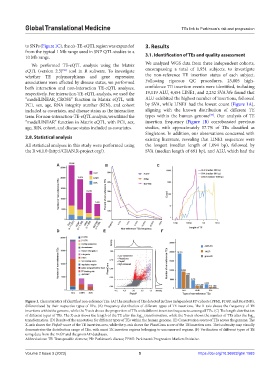
            respectively. For interaction-TE-eQTL analysis, we used the   19,119 ALU, 4,454 LINE1, and 2,232 SVA.We found that
            “modelLINEAR_CROSS” function in Matrix eQTL, with   ALU exhibited the highest number of insertions, followed
            PC1, sex, age, RNA integrity number (RIN), and cohort   by SVA, while LINE1 had the lowest count (Figure 1A),
            included as covariates, and disease status as the interaction   aligning with the known distribution of different TE
                                                                                          [57]
            term. For non-interaction-TE-eQTL analysis, we utilized the   types  within the  human  genome .  Our analysis  of  TE
            “modelLINEAR” function in Matrix eQTL, with PC1, sex,   insertion frequency (Figure  1B) corroborated previous
            age, RIN, cohort, and disease status included as covariates.  studies,  with approximately 57.7% of TEs classified as
                                                               Singletons. In addition, our observations concurred with
            2.8. Statistical analysis                          existing literature, revealing that LINE1 sequences were
            All statistical analyses in this study were performed using   the longest (median length of 1,094  bp), followed by
            the R v4.1.0 (http://CRAN.R-project.org/).         SVA (median length of 691 bp), and ALU, which had the


                         A                    B                     C


                         D                   E                        F


            Figure 1. Characteristics of identified non-reference TEs. (A) The numbers of TEs detected in three independent PD cohorts (PPMI, PDBP, and BioFIND),
            differentiated by their respective types of TEs. (B) Frequency distribution of different types of TE insertions. The X-axis shows the frequency of TE
            insertions within the genome, while the Y-axis shows the proportion of TEs with different insertion frequencies among all TEs. (C) The length distribution
            of different types of TEs. The X-axis shows the length of the TE after the log  transformation, while the Y-axis shows the number of TEs after the log
                                                             10
                                                                                                            10
            transformation. (D) Results of the annotation for different types of TEs within the human genome. (E) Conservation scores of TEs across the genome. The
            X-axis shows the PhyloP score of the TE insertion area, while the y-axis shows the PhastCons score of the TE insertion area. The isodensity map visually
            demonstrates the distribution range of TEs, with most TE insertion regions belonging to unconserved regions. (F) Verification of different types of TE
            using data from the 1KGP and the gnomAD databases.
            Abbreviations: TE: Transposable element; PD: Parkinson’s disease; PPMI: Parkinson’s Progression Markers Initiative.

            Volume 2 Issue 3 (2023)                         5                        https://doi.org/10.36922/gtm.1583

