


Page 112 - GTM-2-3
P. 112
Global Translational Medicine                                     TEs link to Parkinson’s risk and progression


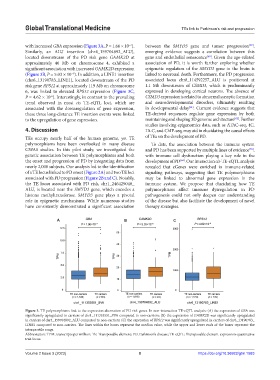
            with increased GBA expression (Figure 3A, P = 1.66 × 10 ).   between the  SMYD3 gene and tumor progression ,
                                                        −7
                                                                                                           [59]
            Similarly, an ALU insertion (chr4_159704892_ALU),   emerging evidence suggests a correlation between this
            located downstream of the PD risk gene  GAMK2D at   gene and endothelial senescence . Given the age-related
                                                                                         [60]
            approximately 46 Mb on chromosome  4, exhibited  a   association of PD,  it is  worth  further  exploring  whether
            significant association with increased GAMK2D expression   epigenetic regulation of the  SMYD3 gene in the brain is
            (Figure 3B, P = 5.03 × 10 ). In addition, a LINE1 insertion   linked to neuronal death. Furthermore, the PD progression
                               −6
            (chr6_13190783_LINE1), located downstream of the PD   associated locus chr8_114592257_ALU is positioned at
            risk gene RPS12 at approximately 119 Mb on chromosome   1.1 Mb downstream of  CSMD3, which is predominantly
            6, was linked to elevated  RPS12 expression (Figure 3C,   expressed in developing cortical neurons. The absence of
                       -6
            P = 4.62 × 10 ). Interestingly, in contrast to the prevailing   CSMD3 expression is related to abnormal synaptic formation
            trend observed in most  cis TE-eQTL loci, which are   and neurodevelopmental disorders, ultimately resulting
                                                                                 [61]
            associated with the downregulation of gene expression,   in developmental delay . Current evidence suggests that
            these three long-distance TE insertion events were linked   TE-derived sequences regulate gene expression by both
            to the upregulation of gene expression.            maintaining and shaping 3D genome architecture . Further
                                                                                                     [62]
                                                               studies involving epigenomics data, such as ATAC-seq, 4C,
            4. Discussion                                      Hi-C, and ChIP-seq, may aid in elucidating the causal effects
            TEs  occupy  nearly  half  of  the  human  genome,  yet  TE   of TEs on the development of PD.
            polymorphisms have been overlooked in many disease   To date, the association between the immune system
            GWAS  studies.  In  this  pilot  study,  we  investigated  the   and PD has been supported by multiple lines of evidence ,
                                                                                                           [63]
            genetic association between TE polymorphisms and both   with immune cell dysfunction playing a key role in the
            the onset and progression of PD by integrating data from   development of PD . Our interaction cis-TE-eQTL analysis
                                                                              [64]
            nearly 2,000 subjects. Our analysis led to the identification   revealed that eGenes were enriched in immune-related
            of a TE locus linked to PD onset (Figure 2A) and two TE loci   signaling pathways, suggesting that TE polymorphisms
            associated with PD progression (Figure 2B and C). Notably,   may be linked to abnormal gene expression in the
            the TE locus associated with PD risk, chr1_246429040_  immune system. We propose that elucidating how TE
            ALU, is located near the SMYD3 gene, which encodes a   polymorphisms  affect  immune  dysregulation  in  PD
            histone methyltransferase.  SMYD3 gene plays a pivotal   pathogenesis could not only deepen our understanding
            role in epigenetic mechanisms. While numerous studies   of the disease but also facilitate the development of novel
            have consistently demonstrated a significant association   therapy strategies.


                         A                            B                    C


            Figure 3. TE polymorphisms link to the expression alternation of PD risk genes. In non-interaction TE-eQTL analysis: (A) the expression of GBA was
            significantly upregulated in carriers of chr1_111353551_SVA compared to non-carriers; (B) the expression of GAMK2D was significantly upregulated
            in carriers of chr4_159704892_ALU compared to non-carriers; (C) the expression of RPS12 was significantly upregulated in carriers of chr6_13190783_
            LINE1 compared to non-carriers. The lines within the boxes represent the median value, while the upper and lower ends of the boxes represent the
            interquartile range.
            Abbreviation: TPM: transcripts per million; TE: Transposable element; PD: Parkinson’s disease; TE-eQTL: Transposable element-expression quantitative
            trait locus.


            Volume 2 Issue 3 (2023)                         8                        https://doi.org/10.36922/gtm.1583

