


Page 45 - GTM-3-3
P. 45
Global Translational Medicine                                         Ocular changes in Alzheimer’s disease


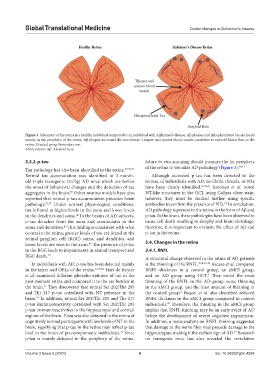
            Figure 3. Schematic of the retina in a healthy individual compared to an individual with Alzheimer’s disease. Aβ plaques and phosphorylated tau are found
            mainly in the periphery of the retina. Aβ plaques surround the vasculature. Thinner and sparser blood vessels contribute to reduced blood flow to the
            retina. Created using Biorender.com.
            Abbreviation: Aβ: Amyloid beta.

            3.3.2. p-tau                                       future in vivo scanning should measure the far periphery
            Tau pathology has also been identified in the retina. 37,39-41    of the retina to visualize AD pathology (Figure 3). 39,41
            Retinal  tau accumulation was identified  in 3-month-  Although  increased  p-tau  has  been  detected  in  the
            old triple transgenic (3×Tg) AD mice which are before   retinas, of individuals with AD, no fibrils, threads, or NTs
            the onset of behavioral changes and the detection of tau   have been clearly identified. 37,39,41  Koronyo  et al. noted
            aggregates in the brain.  Other murine models have also   NT-like structures in the GCL using Gallyas silver stain;
                               40
            reported that retinal p-tau accumulation precedes brain   however,  they  must  be  studied  further  using  specific
                                                                                                22
            pathology. 31,37  Under normal physiological conditions,   antibodies to confirm the presence of NTs.  In conclusion,
            tau is found at higher levels in the axon and lower levels   AD pathology is present in the retina in the form of Aβ and
            in the dendrites and soma.  In the brains of AD subjects,   p-tau. In the brain, these pathologies have been observed to
                                 42
            p-tau detaches from the axon and accumulates in the   cause cell death resulting in atrophy and brain shrinkage;
            soma and dendrites.  This finding is consistent with what   therefore, it is important to evaluate the effect of Aβ and
                            42
            occurs in the retina; greater levels of tau are found in the   p-tau in the retina.
            retinal ganglion cell (RGC) soma, and dendrites, and
            lower levels are seen in the axon.  The presence of p-tau   3.4. Changes in the retina
                                       40
            in the RGC leads to impairments in axonal transport and   3.4.1. RNFL
            RGC death. 40
                                                               A structural change observed in the retina of AD patients
              In individuals with AD, p-tau has been detected mainly   is the thinning of the RNFL. 5,30,43-46  Ascaso et al. compared
            in the inner and OPLs of the retina. 37,39,41  Hart de Ruyter   RNFL thickness in a control group, an aMCI group,
            et al. examined different phospho-epitopes of tau in the   and  an  AD  group  using  OCT.   They  noted  the  most
                                                                                         5
            post-mortem retina and compared it to the tau burden in   thinning of the RNFL in the AD group, some thinning
            the brain.  They discovered that retinal Ser 202/Thr 205   in the aMCI group, and the least amount of thinning in
                    41
            and Thr 217 p-tau correlated with NT presence in the   the control group.  Paquet  et al. also described reduced
                                                                              5
            brain.  In addition, retinal Ser 202/Thr 205 and Thr 217   RNFL thickness in the aMCI group compared to control
                41
            p-tau immunoreactivity correlated with Ser 202/Thr 205   individuals.  Therefore, the thinning in the aMCI group
                                                                        43
            p-tau immunoreactivities in the hippocampal and cortical   implies that RNFL thinning may be an early event of AD
            regions of the brain. P-tau was also detected in the retina of   before the development of severe cognitive impairment.
            cognitively normal participants with low levels of NT in the   In addition, a meta-analysis on RNFL thinning suggested
            brain, signifying that p-tau in the retina may reflect p-tau   that damage to the nerve fiber may precede damage to the
            load in the brain of pre-symptomatic individuals.  Since   hippocampus, making it the earliest sign of AD.  Research
                                                    41
                                                                                                     44
            p-tau is mainly detected in the periphery of the retina,   on transgenic mice has also revealed the correlation
            Volume 3 Issue 3 (2024)                         6                               doi: 10.36922/gtm.4094

