


Page 43 - GTM-3-3
P. 43
Global Translational Medicine                                         Ocular changes in Alzheimer’s disease


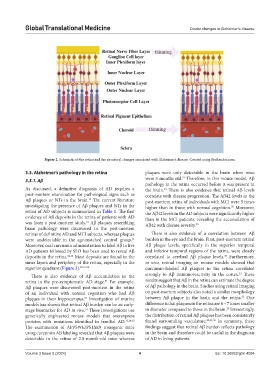
                    Figure 2. Schematic of the retina and the structural changes associated with Alzheimer’s disease. Created using BioRender.com.

            3.3. Alzheimer’s pathology in the retina           plaques were only detectable in the brain when mice
                                                                               31
            3.3.1. Aβ                                          were 5 months old.  Therefore, in this mouse model, Aβ
                                                               pathology in the retina occurred before it was present in
            As discussed, a definitive diagnosis of AD requires a   the  brain.   There is  also evidence that retinal  Aβ  levels
                                                                       31
            post-mortem examination for pathological signs such as   correlate with disease progression. The Aβ42 levels in the
            Aβ plaques or NTs in the brain.  The current literature   post-mortem retina of individuals with MCI were 5 times
                                       15
            investigating the presence of Aβ plaques and NTs in the   higher than in those with normal cognition.  Moreover,
                                                                                                   35
            retina of AD subjects is summarized in Table 1. The first   the Aβ42 levels in the AD subjects were significantly higher
            evidence of Aβ deposits in the retina of patients with AD   than in the MCI patients, revealing the accumulation of
            was from a post-mortem study.  Aβ plaques resembling   Aβ42 with disease severity. 35
                                      31
            brain pathology were discovered in the post-mortem
            retinas of definitive AD and MCI subjects, whereas plaques   There is also evidence of a correlation between Aβ
            were undetectable in the age-matched control  group.    burden in the eye and the brain. First, post-mortem retinal
                                                         31
            Moreover, oral curcumin administration to label Aβ in live   Aβ plaque levels, specifically in the superior temporal
            AD patients followed by SLO has been used to reveal Aβ   and inferior temporal regions of the retina, were closely
            deposits in the retina. 22,32  Most deposits are found in the   correlated to cerebral Aβ plaque levels.  Furthermore,
                                                                                                35
            inner layers and periphery of the retina, especially in the   in vivo, retinal imaging on mouse models showed that
            superior quadrant (Figure 3). 22,31,33             curcumin-labeled Aβ plaques in the retina correlated
                                                                                                       23
              There is also evidence of Aβ accumulation in the   strongly to Aβ immunoreactivity in the cortex.  These
            retina  in  the  pre-symptomatic  AD  stage.   For  example,   results suggest that Aβ in the retina can estimate the degree
                                              31
            Aβ plaques were discovered post-mortem in the retina   of Aβ pathology in the brain. Studies using retinal imaging
            of an individual with normal cognition who had Aβ   on post-mortem subjects also noted a similar morphology
                                                                                                        22
            plaques in their hippocampus.  Investigation of murine   between Aβ plaque in the brain and the retina.  One
                                     31
            models has shown that retinal Aβ burden can be an early-  difference is that plaques in the retina are 6 – 7 times smaller
                                                                                                 22
            stage biomarker for AD in vivo.  These investigations use   in diameter compared to those in the brain.  Interestingly,
                                     31
            genetically engineered mouse models that overexpress   the distribution of retinal Aβ plaques has been consistently
            proteins with mutations identified in familial AD. 31,34,35    found surrounding vasculature. 22,31,36  In summary, these
            The examination of APPSWE/PS1ΔE9 transgenic mice   findings suggest that retinal Aβ burden reflects pathology
            using curcumin Aβ labeling revealed that Aβ plaques were   in the brain and therefore could be useful in the diagnosis
            detectable in the retina of 2.5-month-old mice whereas   of AD in living patients.


            Volume 3 Issue 3 (2024)                         4                               doi: 10.36922/gtm.4094

