


Page 84 - IJAMD-1-3
P. 84
International Journal of AI for
            Materials and Design
                                                                            Review of gas turbine blade failures by erosion


            distributions, guiding the design of more erosion-resistant   analysis with FEA for structural response, may take several
            blades. This coupling allows for iterative analysis, where   hours or days on high-performance computing systems. To
            structural  deformation  feedback  refines  fluid  dynamics   train an ML surrogate model, CFD and FEA simulations
            models, ensuring a more accurate representation of real-  are performed on a limited number of turbine blade
            world conditions and improving blade performance under   configurations under varying conditions (e.g., particle
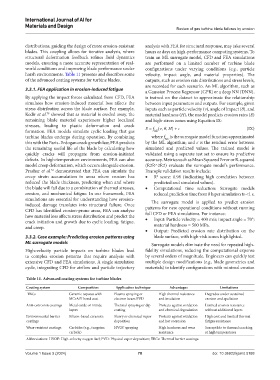
            harsh environments. Table 11 presents and describes some   velocity, impact angle, and material properties). The
            of the advanced coating systems for turbine blades.  outputs, such as erosion rate distributions and stress levels,
                                                               are recorded for each scenario. An ML algorithm, such as
            3.3.1. FEA application in erosion-induced fatigue  a Gaussian Process Regressor (GPR) or a deep NN (DNN),
            By applying the impact forces calculated from CFD, FEA   is trained on the dataset to approximate the relationship
            simulates how erosion-induced material loss affects the   between input parameters and outputs. For example, given
            stress distribution across the blade surface. For example,   inputs such as particle velocity (v), angle of impact (θ), and
            Kedir et al.  showed that as material is eroded away, the   material hardness (H), the model predicts erosion rates (E)
                     78
            remaining blade material experiences higher localized   and high-stress zones using Equation IX:
            stresses, leading to plastic deformation and crack   E = f (v, θ, H) + ϵ                      (IX)
            formation. FEA models simulate cyclic loading that gas   ML
            turbine blades undergo during operation. By combining   where f  is the surrogate model function approximated
                                                                       ML
            this with the Paris–Erdogan crack growth law, FEA predicts   by the ML algorithm; and ϵ is the residual error between
            the remaining useful life of the blade by calculating how   simulated and predicted values. The trained model is
            quickly cracks will propagate from erosion-initiated   validated using a separate test set to ensure its predictive
            defects. In high-temperature environments, FEA can also   accuracy. Metrics such as Mean Squared Error or R-squared
            model creep deformation, which occurs alongside erosion.   (R2R^2R2) evaluate the surrogate model’s performance.
                       32
            Prashar  et al.  demonstrated that FEA can simulate the   Example validation results include:
            creep strain accumulation in areas where erosion has   •   R  score: 0.98 (indicating high correlation between
                                                                    2
            reduced the blade thickness, predicting when and where   predicted and simulated values).
            the blade will fail due to a combination of thermal stresses,   •   Computational time reduction: Surrogate models
            erosion, and mechanical fatigue. In our framework, FEA   reduced prediction time from 8 h per simulation to <1 s.
            simulations are essential for understanding how erosion-  The surrogate model is applied to predict erosion
            induced damage translates into structural failure. Once   patterns for new operational conditions without running
            CFD has identified erosion-prone areas, FEA can analyze   full CFD or FEA simulations. For instance:
            how material loss affects stress distribution and predict the   •   Input: Particle velocity = 400 m/s; impact angle = 70°;
            crack initiation and growth due to cyclic loading, fatigue,
            and creep.                                            material hardness = 500 MPa.
                                                               •   Output: Predicted erosion rate distribution on the
            3.3.2. Case example: Predicting erosion patterns using   blade surface, with high-risk zones highlighted.
            ML surrogate models                                  Surrogate models eliminate the need for repeated high-
            High-velocity particle impacts on turbine blades lead   fidelity simulations, reducing the computational expense
            to complex erosion patterns that require analysis with   by several orders of magnitude. Engineers can quickly test
            extensive CFD and FEA simulations. A single simulation   multiple design modifications (e.g., blade geometries and
            cycle, integrating CFD for airflow and particle trajectory   materials) to identify configurations with minimal erosion

            Table 11. Advanced coating systems for turbine blades

            Coating system        Composition     Application technique  Advantages           Limitations
             TBCs             Ceramic topcoat with   Plasma spraying or   High thermal resistance   Degrades under sustained
                              MCrAlY bond coat    electron beam PVD  and insulation     erosion and spallation
            Anti-corrosion coatings  Metal oxide or nitride   Thermal spraying or dip   Protects against oxidation   Limited erosion resistance
                              layers              coating            and chemical degradation  without additional layers
            Environmental barrier   Silicon-based ceramics  Slurry or chemical vapor   Protects against oxidation   High cost and limited thermal
            coatings                              deposition         and hot corrosion  fatigue resistance
            Wear-resistant coatings  Carbides (e.g., tungsten   HVOF spraying  High hardness and wear   Susceptible to thermal cracking
                              carbide)                               resistance         at high temperatures
            Abbreviations: HVOF: High-velocity oxygen fuel; PVD: Physical vapor deposition; TBCs: Thermal barrier coatings.


            Volume 1 Issue 3 (2024)                         78                             doi: 10.36922/ijamd.5188

