


Page 79 - IJAMD-1-3
P. 79
International Journal of AI for
            Materials and Design
                                                                            Review of gas turbine blade failures by erosion


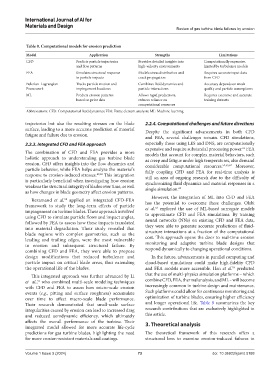
            Table 8. Computational models for erosion prediction
            Model                      Application                 Strengths                  Limitations
            CFD                  Predicts particle trajectories   Provides detailed insights into   Computationally expensive,
                                 and flow patterns          high-velocity environments  limited by turbulence models
            FEA                  Simulates structural response   Models stress distribution and   Requires accurate input data
                                 to particle impacts        crack propagation           from CFD
            Eulerian–Lagrangian   Tracks particle motion and   Combines fluid dynamics and   Accuracy depends on mesh
            Framework            impingement locations      particle interactions       quality and particle assumptions
            ML                   Predicts erosion patterns   Allows rapid predictions,   Requires extensive and accurate
                                 based on prior data        reduces reliance on         training datasets
                                                            computational resources
            Abbreviations: CFD: Computational fluid dynamics; FEA: Finite element analysis; ML: Machine learning.

            trajectories but also the resulting stresses on the blade   2.2.4. Computational challenges and future directions
            surface, leading to a more accurate prediction of material   Despite the significant advancements in both CFD
            fatigue and failure due to erosion.
                                                               and FEA, several challenges remain. CFD simulations,
            2.2.3. Integrated CFD and FEA approach             especially those using LES and DNS, are computationally
                                                               expensive and require substantial processing power.  FEA
                                                                                                        61
            The combination of CFD and FEA provides a more     models that account for complex material behaviors, such
            holistic approach to understanding gas turbine blade   as creep and fatigue under high temperatures, also demand
            erosion. CFD offers insights into the flow dynamics and   considerable  computational  resources. 52,53,62   Moreover,
            particle behavior, while FEA helps analyze the material’s   fully coupling CFD and FEA for real-time analysis is
            response to erosion-induced stresses. 49,60  This integration   still an area of ongoing research due to the difficulty of
            is particularly beneficial when investigating how erosion   synchronizing fluid dynamics and material responses in a
            weakens the structural integrity of blades over time, as well   single simulation. 63
            as how changes in blade geometry affect erosion patterns.
                                                                 However, the integration of ML into CFD and FEA
                            50
              Rezamand  et al.  applied an integrated CFD-FEA
            framework to study the long-term effects of particle   has the potential to overcome these challenges. Olabi
                                                               et al.  explored the use of ML-based surrogate models
                                                                   53
            impingement on turbine blades. Their approach involved   to approximate CFD and FEA simulations. By training
            using CFD to simulate particle flows and impact angles,   neural networks (NNs) on existing CFD and FEA data,
            followed by FEA to assess how these impacts translated   they were able to generate accurate predictions of fluid-
            into material degradation. Their study revealed that
            blade regions with complex geometries, such as the   structure interactions at a fraction of the computational
            leading and trailing edges, were the most vulnerable   cost. This approach opens the door to real-time erosion
            to erosion and subsequent structural failure. By   monitoring and adaptive turbine blade designs that
            combining CFD and FEA, they were able to propose   respond dynamically to changing operational conditions.
            design modifications that reduced turbulence and     In the future, advancements in parallel computing and
            particle impact on critical blade areas, thus extending   cloud-based simulations could make high-fidelity CFD
            the operational life of the blades.                and FEA models more accessible. Han  et al.  predicted
                                                                                                    54
              This integrated approach was further advanced by Li   that the use of multi-physics simulation platforms – which
            et  al.,  who combined multi-scale modeling techniques   combine CFD, FEA, thermal analysis, and ML – will become
                 51
            with CFD and FEA to assess how micro-scale erosion   increasingly common in turbine design and maintenance.
            events (e.g., pitting and surface roughness) accumulate   Such platforms could allow for continuous monitoring and
            over  time  to affect  macro-scale blade  performance.   optimization of turbine blades, ensuring higher efficiency
            Their research demonstrated that small-scale surface   and longer operational life.  Table  9 summarizes the key
            irregularities caused by erosion can lead to increased drag   research contributions that are exclusively highlighted in
            and reduced aerodynamic efficiency, which ultimately   this article.
            affects the overall performance of the turbine. Their   3. Theoretical analysis
            integrated model allowed for more accurate life-cycle
            predictions for gas turbine blades, highlighting the need   The theoretical framework of this research offers a
            for more erosion-resistant materials and coatings.  structured lens to  examine erosion-induced  failures  in


            Volume 1 Issue 3 (2024)                         73                             doi: 10.36922/ijamd.5188

