


Page 74 - IJAMD-1-3
P. 74
International Journal of AI for
            Materials and Design
                                                                            Review of gas turbine blade failures by erosion


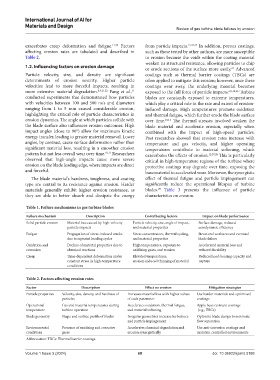
            exacerbates creep deformation and fatigue. 11,20  Factors   from particle impacts. 12,23,24  In addition, porous coatings,
            affecting erosion rates are tabulated and described in   such as those tested by other authors, are more susceptible
            Table 2.                                           to erosion because the voids within the coating material
                                                               weaken its structural resistance, allowing particles to chip
            1.2. Influencing factors on erosion damage         or erode sections of the surface more easily.  Advanced
                                                                                                   25
            Particle velocity, size, and density are significant   coatings  such  as  thermal  barrier  coatings  (TBCs)  are
            determinants of erosion severity. Higher particle   often applied to mitigate this erosion; however, once these
            velocities lead to more forceful impacts, resulting in   coatings wear away, the underlying material becomes
            more extensive material degradation. 8,9,21,22  Fang  et al.,    exposed to the full force of particle impacts. 6,9,10,26  Turbine
                                                         11
            conducted experiments that demonstrated how particles   blades  are constantly  exposed to extreme temperatures,
            with velocities between 100 and 500  m/s and diameters   which play a critical role in the rate and extent of erosion-
            ranging from 1 to 5  mm caused considerable erosion,   induced damage. High temperatures promote oxidation
            highlighting the critical role of particle characteristics in   and thermal fatigue, which further erode the blade surface
            erosion dynamics. The angle at which particles collide with   over time. 10,11  The thermal stresses involved weaken the
            the blade surface also influences erosion outcomes. High   blade material and accelerate erosion, especially when
            impact angles (close to 90°) allow for maximum kinetic   combined with the impact of high-speed particles.
            energy transfer, leading to greater material removal. Lower   Past researches showed that erosion rates increase with
            angles, by contrast, cause surface deformation rather than   temperature and gas velocity, and higher operating
            significant material loss, resulting in a smoother erosion   temperatures contribute to material softening, which
            pattern but not less overall wear over time. 10,11  Researchers   exacerbates the effects of erosion. 12,27,28  This is particularly
            observed that high-angle impacts cause more severe   critical in high-temperature regions of the turbine where
            erosion on the blade leading edge, where impacts are direct   protective coatings may degrade over time, exposing the
            and forceful.                                      base material to accelerated wear. Moreover, the synergistic

              The blade material’s hardness, toughness, and coating   effect of thermal fatigue and particle impingement can
            type are central to its resistance against erosion. Harder   significantly reduce the operational lifespan of turbine
                                                                    29
            materials generally exhibit higher erosion resistance, as   blades.   Table  3 presents the influence of particle
            they are able to better absorb and dissipate the energy   characteristics on erosion.
            Table 1. Failure mechanisms in gas turbine blades

            Failure mechanism         Description              Contributing factors    Impact on blade performance
            Solid particle erosion   Material loss caused by high-velocity   Particle velocity, size, angle of impact,   Surface damage, reduced
                              particle impacts            and material properties    aerodynamic efficiency
            Fatigue           Propagation of stress-induced cracks   Stress concentrators, thermal cycling,   Structural weakness and eventual
                              due to repeated loading cycles  and material properties  blade failure
            Oxidation and     Decline of material properties due to   High temperatures, exposure to   Accelerated material loss and
            corrosion         chemical reactions          oxidizing gases, and erosion  reduced durability
            Creep             Time-dependent deformation under   Elevated temperatures,   Reduced load-bearing capacity and
                              constant stress in high-temperature   erosion-induced thinning of material  rupture
                              conditions

            Table 2. Factors affecting erosion rates

            Factor                  Description                Effect on erosion          Mitigation strategies
            Particle properties  Velocity, size, density, and hardness of   Increases material loss with higher values   Use harder materials and optimized
                           particles                   of each parameter             coatings
            Operational    Gas and material temperatures during   Accelerates oxidation, thermal fatigue,   Apply heat-resistant coatings
            temperature    turbine operation           and material softening         (e.g., TBCs)
            Blade geometry  Shape and surface profile of blades  Irregular geometries increase turbulence   Optimize blade design to minimize
                                                       and particle impingement      flow separation
            Environmental   Presence of oxidizing and corrosive   Accelerates chemical degradation and   Use anti-corrosion coatings and
            conditions     gases                       erosion synergistically       maintain controlled environments
            Abbreviation: TBCs: Thermal barrier coatings.


            Volume 1 Issue 3 (2024)                         68                             doi: 10.36922/ijamd.5188

