


Page 76 - IJAMD-1-3
P. 76
International Journal of AI for
            Materials and Design
                                                                            Review of gas turbine blade failures by erosion


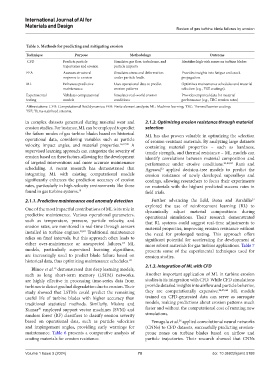
            Table 5. Methods for predicting and mitigating erosion
            Technique            Purpose                Methodology                       Outcome
             CFD            Predicts particle    Simulates gas flow, turbulence, and   Identifies high-risk zones on turbine blades
                            trajectories and erosion  particle impacts
            FEA             Assesses structural   Simulates stress and deformation   Provides insights into fatigue and crack
                            response to erosion  under particle loads.        propagation.
            ML              Enhances predictive   Uses operational data to predict   Optimizes maintenance schedules and material
                            maintenance.         erosion patterns             selection (e.g., YSZ coatings).
            Experimental    Validates computational   Simulates real-world erosion   Provides empirical data for material
            testing         models               conditions                   performance (e.g., TBC erosion rates)
            Abbreviations: CFD: Computational fluid dynamics; FEA: Finite element analysis; ML: Machine learning; TBC: Thermal barrier coating;
            YSZ: Yttria-stabilized zirconia.

            in  complex  datasets  generated  during  material  wear  and   2.1.2. Optimizing erosion resistance through material
            erosion studies. For instance, ML can be employed to predict   selection
            the failure modes of gas turbine blades based on historical   ML has also proven valuable in optimizing the selection
            operational data, considering variables such as particle   of erosion-resistant materials. By analyzing large datasets
            velocity, impact angles, and material properties. 16,17,38  A   containing material properties – such as hardness,
            supervised learning approach can categorize the severity of   tensile strength, and thermal resistance – ML models can
            erosion based on these factors, allowing for the development   identify correlations between material composition and
            of targeted interventions and more accurate maintenance   performance under erosive conditions. 21,42,43  Rani and
            scheduling. A  recent research has demonstrated that   Agrawal  applied decision-tree models to predict the
                                                                     22
            integrating ML with existing computational models   erosion  resistance  of newly developed superalloys  and
            significantly enhances the prediction accuracy of erosion   coatings, allowing researchers to focus their experiments
            rates, particularly in high-velocity environments like those   on materials with the highest predicted success rates in
            found in gas turbine systems. 18                   field trials.
                                                                                                            23
            2.1.1. Predictive maintenance and anomaly detection  Further advancing the field, Bonu and Barshilia
                                                               explored the use of reinforcement learning (RL) to
            One of the most impactful contributions of ML is its role in   dynamically adjust material compositions  during
            predictive maintenance. Various operational parameters,   operational simulations. Their research demonstrated
            such as temperature, pressure, particle velocity, and   that  RL  systems  could  suggest  real-time  adjustments  to
            erosion rates, are monitored in real-time through sensors   material properties, improving erosion resistance without
            installed in turbine engines. 39,40  Traditional maintenance   the  need  for  prolonged  testing.  This  approach  offers
            relies on fixed intervals, but this approach often leads to   significant potential  for accelerating  the development of
            either over-maintenance or unexpected failures.  ML   more robust materials for gas turbine applications. Table 7
                                                     18
            models, particularly supervised learning algorithms,   presents some of the experimental techniques used for
            are increasingly used to predict blade failure based on   erosion studies.
            historical data, thus optimizing maintenance schedules. 41
                                                               2.1.3. Integration of ML with CFD
              Blinov et al.  demonstrated that deep learning models,
                        19
            such as long short-term memory (LSTM) networks,    Another important application of ML in turbine erosion
            are highly effective in processing time-series data from   studies is its integration with CFD. While CFD simulations
            turbines to detect gradual degradation due to erosion. Their   provide detailed insights into airflow and particle behavior,
            study showed that LSTMs could predict the remaining   they are computationally expensive. 24,25,44  ML models
            useful life of turbine blades with higher accuracy than   trained on CFD-generated data can serve as surrogate
            traditional statistical methods. Similarly, Mishra and   models, making predictions about erosion patterns much
            Kumar  employed support vector machines (SVM) and   faster and without the computational cost of running new
                 20
            random forest (RF) classifiers to classify erosion severity   simulations.
            based  on  operational  data,  such  as  particle  velocities   Yenugula et al.  applied convolutional neural networks
                                                                             26
            and impingement angles, providing early warnings for   (CNNs) to CFD datasets, successfully predicting erosion-
            maintenance.  Table  6 presents a comparative analysis of   prone zones on turbine blades based on airflow and
            coating materials for erosion resistance.          particle trajectories. Their research showed that CNNs


            Volume 1 Issue 3 (2024)                         70                             doi: 10.36922/ijamd.5188

