


Page 75 - IJAMD-1-3
P. 75
International Journal of AI for
            Materials and Design
                                                                            Review of gas turbine blade failures by erosion


            1.3. Mitigation strategies                         extending the operational life of gas turbine blades. These

            The  use  of  coatings  and  erosion-resistant  materials  is   advancements also enable more efficient maintenance
                                                                                                           33,34
            essential in mitigating the effects of erosion. TBCs, which   strategies, reducing downtime and operational costs.
            consist of multiple layers including bond coats and thermal   Erosion mechanisms across turbine blade zones are listed
            barriers, help to protect the underlying substrate from   and described in Table 4.
            extreme temperatures and particle impacts. These coatings   2. Method for predicting and mitigating
            reduce  the  thermal  and  mechanical  stresses  exerted  on
            the  blade. 13,30   However,  when  TBCs  begin  to  wear  away   erosion
            under sustained particle impacts, the underlying material   Recent advancements in analytical methods have
            becomes vulnerable, accelerating erosion and leading to   revolutionized the field of material degradation, specifically
            more rapid structural degradation.                 in addressing challenges such as erosion-induced failures in
              Modifications to the geometry of turbine blades can   gas turbine blades. 10,12,14  Machine learning (ML) and other
            also help minimize erosion. Redesigning the leading   advanced computational techniques such as CFD and FEA
            edges to reduce the incidence of particle impacts or   are now being increasingly employed to enhance predictive
            altering the airflow pattern can reduce the rate of erosion,   capabilities and provide more efficient mitigation strategies
            as  highlighted by  simulations and  studies  employing   for erosion.  Table 5 delineates the methods for predicting
                                                                        35
            computational fluid dynamics (CFD) and finite element   and mitigating erosion.
            analysis (FEA) to predict erosion-prone zones and stress
            points. 14,31  Reducing turbulence and optimizing airflow   2.1. ML applications
            in  these  regions  helps  lower  erosion  intensity,  thereby   In recent years, ML has emerged as a powerful tool in the field
            prolonging blade life.                             of material science and mechanical engineering, particularly
              In summary, erosion-induced failures in gas turbine   in predictive maintenance and failure analysis. 15,36  The
            blades result from a complex interplay of mechanical   application of ML in gas turbine blade erosion studies has
            and environmental factors, including particle impact   opened new avenues for improving reliability, extending
            characteristics, material properties, and operational   operational life, and optimizing maintenance schedules. The
            conditions. 13,14,32  By understanding these mechanisms and   ability of ML to analyze large datasets and extract complex
            the factors influencing erosion, researchers can develop   patterns has revolutionized the way engineers approach
            more resilient materials, effective coatings, and optimized   predictive modeling for gas turbine blade erosion.  ML
                                                                                                         37
            blade designs to reduce erosion’s impact, thereby   algorithms are becoming invaluable in identifying patterns

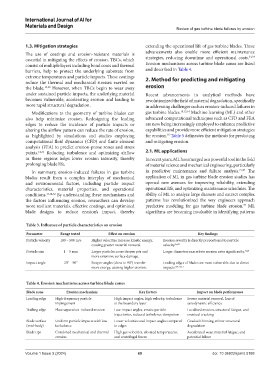
            Table 3. Influence of particle characteristics on erosion
            Parameter      Range tested        Effect on erosion                     Key findings
            Particle velocity  100 – 500 m/s  Higher velocities increase kinetic energy,   Erosion severity is directly proportional to particle
                                        causing greater material removal.  velocity. 5,6,11
            Particle size   1 – 5 mm    Larger particles cause deeper pits and   Larger diameters exacerbate erosion rates significantly. 3,4,6
                                        more extensive surface damage.
            Impact angle    20° – 90°   Steeper angles (close to 90°) transfer   Leading edges of blades are most vulnerable due to direct
                                        more energy, causing higher erosion.  impacts. 8,9,12,13


            Table 4. Erosion mechanisms across turbine blade zones

            Blade zone       Erosion mechanism              Key factors              Impact on blade performance
            Leading edge  High-frequency particle   High impact angles, high velocity, turbulence   Severe material removal, loss of
                         impingement              at the boundary layer          aerodynamic efficiency
            Trailing edge  Flow separation-induced erosion  Low impact angles, erratic particle   Localized erosion, structural fatigue, and
                                                  trajectories, reduced turbulence dissipation  eventual cracking
            Blade surface   Uniform particle impacts with low   Lower velocities and impact angles compared   Gradual thinning, minor structural
            (mid-body)   turbulence.              to edges                       degradation
            Blade tips   Combined mechanical and thermal   High gas velocities, elevated temperatures,   Accelerated wear, material fatigue, and
                         erosion                  and centrifugal forces         potential failure


            Volume 1 Issue 3 (2024)                         69                             doi: 10.36922/ijamd.5188

