


Page 44 - IJAMD-2-2
P. 44
International Journal of AI for
            Materials and Design                                           ML-driven optimization in additive manufacturing


                        A                       B


                        C


                        D


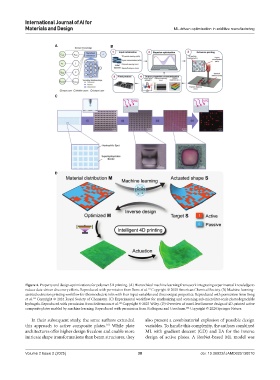
            Figure 4. Property and design optimizations for polymer 3D printing. (A) Hierarchical machine learning framework integrating experimental knowledge to
            reduce data-driven discovery efforts. Reproduced with permission from Bone et al. Copyright © 2020 American Chemical Society. (B) Machine learning-
                                                                111
            assisted extrusion printing workflow for thermoelectric inks with four input variables and three output properties. Reproduced with permission from Song
            et al.  Copyright © 2024 Royal Society of Chemistry. (C) Experimental workflow for synthesizing and screening sub-microliter-scale photodegradable
               114
            hydrogels. Reproduced with permission from Seifermann et al.  Copyright © 2023 Wiley. (D) Overview of voxel-level inverse design of 4D-printed active
                                                   116
            composite plates enabled by machine learning. Reproduced with permission from Rodriguez and Goodman.  Copyright © 2024 Springer Nature.
                                                                                122
              In their subsequent study, the same authors extended   also present a combinatorial explosion of possible design
                                              116
            this approach to active composite plates.  While plate   variables. To handle this complexity, the authors combined
            architectures offer higher design freedom and enable more   ML with gradient descent (GD) and EA for the inverse
            intricate shape transformations than beam structures, they   design of  active  plates.  A  ResNet-based  ML  model  was


            Volume 2 Issue 2 (2025)                         38                        doi: 10.36922/IJAMD025130010

