


Page 63 - IJAMD-2-2
P. 63
International Journal of AI for
            Materials and Design
                                                                               A unified industrial AI foundation framework


            Section 2 reviews related work; Section 3 redefines the   and industrial application areas. On the other hand, Zhang
            role of industrial AI; Section 4 introduces the proposed   et al.  developed a comprehensive reference framework
                                                                   15
            foundation framework; Section 5 provides a case study on   structured  around  seven  critical  dimensions  (object,
            rotating machinery diagnosis; Section 6 discusses future   domain, stage, requirement, technology, function, and
            directions; and Section 7 concludes the paper.     solutions). In addition, Yang et al.  proposed an intelligent
                                                                                         16
                                                               manufacturing framework combining human-machine
            2. Related work                                    cooperation with autonomous intelligent control systems
                                                                                                            17
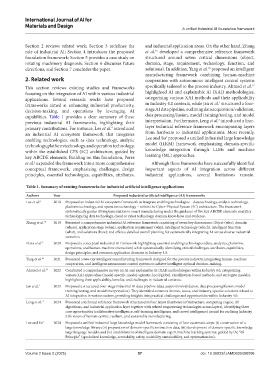
            This section reviews existing studies and frameworks   specifically tailored to the process industry. Ahmed et al.
            focusing on the integration of AI within various industrial   highlighted AI and explainable AI (XAI) methodologies,
            applications. Several research works have proposed   categorizing various XAI methods and their applicability
                                                                                              1
            frameworks  aimed  at  enhancing  industrial  productivity,   in Industry 4.0 contexts, while Jan et al.  structured a four-
            decision-making, and operations by leveraging AI   stage AI data pipeline, outlining data acquisition/validation,
            capabilities.  Table 1 provides a clear summary of these   data processing/fusion, model training/testing, and model
                                                                                              3
            previous industrial AI frameworks, highlighting their   interpretation. Furthermore, Leng et al.  introduced a four-
            primary contributions. For instance, Lee et al.  introduced   layer technical reference framework encompassing layers
                                                4
            an industrial AI ecosystem framework that integrates   from hardware to industrial applications. Most recently,
                                                                        7
            enabling technologies, such as data technology, analytic   Lee and Su  proposed a unified industrial large knowledge
            technology, platform technology, and operation technology,   model (ILKM) framework emphasizing domain-specific
            within the established CPS (5C) architecture, guided by   knowledge integration through LLMs and machine
            key ABCDE elements. Building on this foundation, Peres   learning (ML) approaches.
            et al.  expanded the framework into a more comprehensive   Although these frameworks have successfully identified
                2
            conceptual framework,  emphasizing  challenges,  design   important aspects of AI integration across different
            principles, essential technologies, capabilities, attributes,   industrial applications, several limitations remain.

            Table 1. Summary of existing frameworks for industrial artificial intelligence applications
            Authors     Year                     Proposed industrial artificial intelligence (AI) frameworks
            Lee et al. 4  2018  Proposed an industrial AI ecosystem framework to integrate enabling technologies – data technology, analytic technology,
                             platform technology, and operation technology – within the Cyber-Physical System (5C) architecture. The framework
                             systematically guides AI implementation in smart manufacturing under the guidance of five key ABCDE elements: analytics
                             technology, big data technology, cloud or cyber technology, domain know-how, and evidence.
            Zhang et al. 15  2019  Presented a comprehensive industrial AI reference framework consisting of seven key dimensions: Object (who), domain
                             (where), application stage (when), application requirement (why), intelligent technology (which), intelligent function
                             (what), and solutions (how); and offers a detailed overall planning for systematically integrating AI across diverse industrial
                             scenarios.
            Peres et al. 2  2020  Proposed a conceptual industrial AI framework highlighting essential enabling technologies (data, analytics, platforms,
                             operations, and human-machine interaction) while systematically identifying critical challenges, attributes, capabilities,
                             design principles, and common application domains in Industry 4.0.
            Yang et al. 16  2021  Presented a two-tier intelligent manufacturing framework designed for the process industry, integrating human-machine
                             cooperation, and intelligent autonomous control systems to achieve intelligent optimal decision-making.
            Ahmed et al. 17  2022  Conducted a comprehensive survey on AI and explainable AI (XAI) methodologies within Industry 4.0, categorizing
                             various XAI approaches (model-specific, model-agnostic, local/global, visualization-based methods, and surrogate models),
                             highlighting their applicability, benefits, and challenges in industrial contexts.
            Jan et al. 1  2023  Proposed a structured, four-stage industrial AI data pipeline (data acquisition/validation, data processing/fusion, model
                             training/testing, and model interpretation). They identified common themes, issues, and industry-specific solutions related to
                             AI integration in various sectors, providing insights into practical challenges and opportunities within Industry 4.0.
            Leng et al.  3  2024  Presented a technical reference framework structured in four layers (hardware infrastructure, computing engine, AI
                             algorithms, and industrial application layer together with related empowering technologies across layers), identifying three
                             core opportunities (collaborative intelligence, self-learning intelligence, and crowd intelligence) crucial for realizing Industry
                             5.0’s vision of human-centric, resilient, and sustainable manufacturing.
            Lee and Su 7  2024  Proposed a unified industrial large knowledge model framework consisting of four systematic steps: (i) construction of a
                             large knowledge library; (ii) preparation of domain-specific instruction data; (iii) development of domain-specific knowledge
                             large language models; and (iv) establishment of intelligent domain expert machine learning systems; guided by the “6S
                             Principle” (specialized knowledge, scrutability, safety, scalability, sustainability, and systematization).


            Volume 2 Issue 2 (2025)                         57                        doi: 10.36922/IJAMD025080006

