


Page 64 - IJAMD-2-2
P. 64
International Journal of AI for
            Materials and Design
                                                                               A unified industrial AI foundation framework


            These  include  the lack of  systematic  domain-specific   basis of domain knowledge, which contains accumulated
            knowledge integration, a tendency to focus on theoretical   experience, research insights, and best practices from
            conceptualization without clear and objective guidelines,   AI-driven approaches. With the rise of IoT technology,
            and an overemphasis on data and models without sufficient   things, including machines, sensors, and other devices,
            attention to systematic thinking that connects knowledge,   generate vast amounts of data, which is an essential
            data, and models. Motivated by these gaps, the following   prerequisite for conducting industrial AI analytics,
            two sections revisit the role of industrial AI and present   modeling, and decision-making in modern industry.
            a unified industrial AI foundation framework aimed at   Moreover, systems such as CPS, IIoT systems, and other
            addressing these critical shortcomings.            intelligent industrial systems use AI models to automate
                                                               operations, enable intelligent decision-making, and
            3. Rethinking the role of industrial AI            improve real-time control.
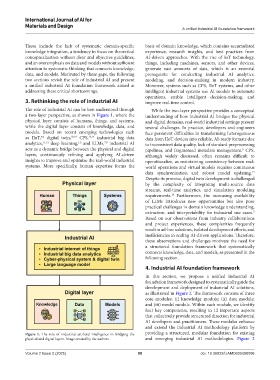
            The role of industrial AI can be best understood through   While the two-layer perspective provides a conceptual
            a two-layer perspective, as shown in Figure 1, where the   understanding of how industrial AI bridges the physical
            physical layer consists of humans, things, and systems,   and digital domains, real-world industrial settings present
            while the digital layer consists of knowledge, data, and   several challenges. In practice, developers and engineers
            models. Based on recent emerging technologies such   face persistent difficulties in transforming heterogeneous
            as  IIoT,   digital  twin, 18,19   CPS, 13,14   industrial  big  data   data from IIoT devices into reliable, AI-ready formats due
                  5,6
            analytics, 11,12  deep learning,  and LLMs,  industrial AI   to inconsistent data quality, lack of standard preprocessing
                                             7,8
                                  1,2
            acts as a dynamic bridge between the physical and digital   pipelines, and fragmented metadata management.  CPS,
                                                                                                        5
            layers, continuously refining and applying AI-driven   although widely discussed, often remains difficult to
            insights to improve and optimize the real-world industrial   operationalize, as maintaining consistency between real-
            systems. More specifically, human expertise forms the   world operations and virtual models requires continuous
                                                               data synchronization and robust model updating.
                                                                                                            13
                                                               Despite its promise, digital twin development is challenged
                                                               by the complexity of integrating multi-source data
                                                               streams,  real-time  analytics,  and  simulation  modeling
                                                               requirements.  Furthermore, the increasing availability
                                                                          18
                                                               of LLMs introduces new opportunities but also pose
                                                               practical challenges in domain knowledge understanding,
                                                               extraction, and interpretability for industrial use cases.
                                                                                                             7
                                                               Based on our observations from industry collaborations
                                                               and project experiences, these complexities frequently
                                                               result in ad-hoc solutions, isolated development efforts, and
                                                               inefficiencies in scaling AI-driven applications. Therefore,
                                                               these observations and challenges motivate the need for
                                                               a  structured  foundation  framework  that  systematically
                                                               connects knowledge, data, and models, as presented in the
                                                               following section.
                                                               4. Industrial AI foundation framework
                                                               In this section, we propose a unified industrial AI
                                                               foundation framework designed to systematically guide the
                                                               development and deployment of industrial AI solutions,
                                                               as illustrated in Figure 2. The framework consists of three
                                                               core modules: (i) knowledge module; (ii) data module;
                                                               and (iii) model module. Within each module, we identify
                                                               four key components, resulting in 12 important aspects
                                                               that collectively provide structured direction for industrial
                                                               AI developers and practitioners. These modules enhance
                                                               and extend the industrial AI methodology platform by
            Figure  1. The role of industrial artificial intelligence in bridging the   providing a structured, modular foundation for existing
            physical and digital layers. Image created by the authors.  and emerging industrial  AI methodologies.  Figure  2


            Volume 2 Issue 2 (2025)                         58                        doi: 10.36922/IJAMD025080006

