


Page 80 - IJAMD-2-2
P. 80
International Journal of AI for
            Materials and Design                                                   Prediction of AM defect based on DL


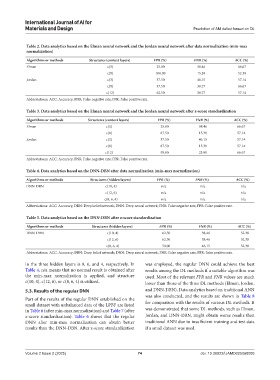
            Table 2. Data analytics based on the Elman neural network and the Jordan neural network after data normalization (min‑max
            normalization)
            Algorithms or methods      Structures (context layers)  FPR (%)         FNR (%)          ACC (%)
            Elman                              c(3)                 25.00            38.46            66.67
                                               c(8)                100.00            15.38            52.38
            Jordan                             c(3)                 37.50            46.15            57.14
                                               c(8)                 37.50            30.77            66.67
                                              c(12)                 62.50            30.77            57.14
            Abbreviations: ACC: Accuracy; FNR: False negative rate; FPR: False positive rate.

            Table 3. Data analytics based on the Elman neural network and the Jordan neural network after z‑score standardization
            Algorithms or methods     Structures (context layers)   FPR (%)         FNR (%)          ACC (%)
            Elman                             c(3)                   25.00            38.46           66.67
                                              c(8)                   87.50            15.38           57.14
            Jordan                            c(3)                   37.50            46.15           57.14
                                              c(8)                   87.50            15.38           57.14
                                              c(12)                  50.00            23.08           66.67
            Abbreviations: ACC: Accuracy; FNR: False negative rate; FPR: False positive rate.

            Table 4. Data analytics based on the DNN‑DBN after data normalization (min‑max normalization)
            Algorithms or methods      Structures (hidden layers)   FPR (%)         FNR (%)          ACC (%)
            DNN-DBN                           c(10, 4)                n/a             n/a              n/a
                                              c(12, 6)                n/a             n/a              n/a
                                             c(8, 6, 4)               n/a             n/a              n/a
            Abbreviations: ACC: Accuracy; DBN: Deep belief network; DNN: Deep neural network; FNR: False negative rate; FPR: False positive rate.

            Table 5. Data analytics based on the DNN‑DBN after z‑score standardization

            Algorithms or methods       Structures (hidden layers)   FPR (%)          FNR (%)         ACC (%)
            DNN-DBN                            c(10, 4)               62.50            38.46           52.38
                                               c(12, 6)               62.50            38.46           52.38
                                              c(8, 6, 4)              50.00            46.15           52.38
            Abbreviations: ACC: Accuracy; DBN: Deep belief network; DNN: Deep neural network; FNR: False negative rate; FPR: False positive rate.

            in the three hidden layers is 8, 6, and 4, respectively. In   was employed, the regular DNN could achieve the best
            Table 4, n/a means that no normal result is obtained after   results among the DL methods if a suitable algorithm was
            the min-max normalization is applied, and structure   used. Most of the relevant FPR and FNR values are much
            c(10, 4), c(12, 6), or c(8, 6, 4) is utilized.     lower than those of the three DL methods (Elman, Jordan,
            5.3. Results of the regular DNN                    and DNN-DBN). Data analytics based on traditional ANN
                                                               was also conducted, and the results are shown in Table 8
            Part of the results of the regular DNN established on the
            small dataset with unbalanced data of the LPBF are listed   for comparison with the results of various DL methods. It
            in Table 6 (after min-max normalization) and Table 7 (after   was demonstrated that some DL methods, such as Elman,
            z-score standardization).  Table  6 shows that the regular   Jordan, and DNN-DBN, might obtain worse results than
            DNN after min-max normalization can obtain better   traditional ANN due to insufficient training and test data
            results than the DNN-DBN. After z-score standardization   if a small dataset was used.


            Volume 2 Issue 2 (2025)                         74                        doi: 10.36922/IJAMD025060005

