


Page 81 - IJAMD-2-2
P. 81
International Journal of AI for
            Materials and Design                                                   Prediction of AM defect based on DL


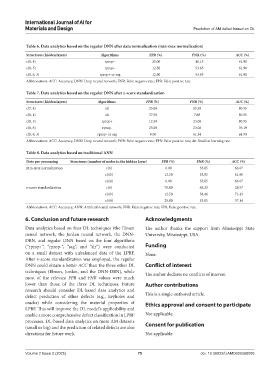
            Table 6. Data analytics based on the regular DNN after data normalization (min‑max normalization)
            Structures (hidden layers)      Algorithms           FPR (%)           FNR (%)           ACC (%)
            c(8, 4)                           rprop−              25.00             46.15              61.90
            c(8, 5)                           rprop−              12.50             53.85              61.90
            c(8, 6, 3)                      rprop+ or sag         12.50             53.85              61.90
            Abbreviations: ACC: Accuracy; DNN: Deep neural network; FNR: False negative rate; FPR: False positive rate

            Table 7. Data analytics based on the regular DNN after z‑score standardization
            Structures (hidden layers)     Algorithms          FPR (%)            FNR (%)            ACC (%)
            c(7, 4)                           slr               25.00              15.38               80.95
            c(8, 4)                           slr               37.50               7.69               80.95
            c(8, 5)                         rprop+              12.50              23.08               80.95
            c(8, 6)                          rprop-             25.00              23.08               76.19
            c(8, 6, 3)                    rprop- or sag          0.00              61.54               61.90
            Abbreviations: ACC: Accuracy; DNN: Deep neural network; FNR: False negative rate; FPR: False positive rate; slr: Smallest learning rate.

            Table 8. Data analytics based on traditional ANN
            Data pre‑processing  Structures (number of nodes in the hidden layer)  FPR (%)  FNR (%)  ACC (%)
            Min-max normalization             c(6)                     0.00           53.85          66.67
                                              c(10)                    12.50          53.85          61.90
                                              c(14)                    0.00           53.85          66.67
            z-score standardization           c(6)                     75.00          69.23          28.57
                                              c(10)                    12.50          38.46          71.43
                                              c(14)                    25.00          53.85          57.14
            Abbreviations: ACC: Accuracy; ANN: Artificial neural network; FNR: False negative rate; FPR: False positive rate.

            6. Conclusion and future research                  Acknowledgments

            Data analytics based on four DL techniques (the Elman   The author thanks the support from Mississippi State
            neural network, the Jordan neural network, the DNN-  University, Mississippi, USA.
            DBN, and regular DNN based on the four algorithms
            (“rprop+”, “rprop-“, “sag”, and “slr”) were conducted   Funding
            on a small dataset with unbalanced data of the LPBF.   None.
            After z-score standardization was employed, the regular
            DNN could obtain a better ACC than the three other DL   Conflict of interest
            techniques (Elman, Jordan, and the DNN-DBN), while   The author declares no conflicts of interest.
            most of the relevant  FPR  and FNR values were much
            lower than those of the three DL techniques. Future   Author contributions
            research should consider DL-based data analytics and
            defect prediction of other defects (e.g., keyholes and   This is a single-authored article.
            cracks) while considering the material properties of   Ethics approval and consent to participate
            LPBF. This will improve the DL model’s applicability and
            enable a more comprehensive defect classification in LPBF   Not applicable.
            processes. DL-based data analytics on more AM datasets
            (small or big) and the prediction of related defects are also   Consent for publication
            directions for future work.                        Not applicable.


            Volume 2 Issue 2 (2025)                         75                        doi: 10.36922/IJAMD025060005

