


Page 85 - IJB-2-2
P. 85
Kuppuswamy Hariharan and Ganesan Arumaikkannu

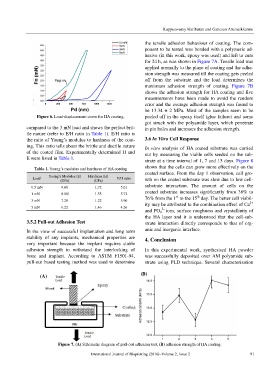
                                                               the tensile  adhesion behaviour of coating. The com-
                                                               ponent to be tested was bonded with a polymeric ad-
                                                               hesive (in this work, epoxy was used) and left to cure
                                                               for 24 h, as was shown in Figure 7A. Tensile load was
                                                               applied normally to the plane of coating and the adhe-
                                                               sion strength was measured till the coating gets peeled
                                                               off  from the substrate and  the load determines the
                                                               maximum adhesion strength of  coating.  Figure 7B
                                                               shows the adhesion strength for HA coating and five
                                                               measurements have been made  to  avoid  the  random
                                                               error and the average adhesion strength was found to
                                                               be 13.34  ±  2 MPa. Most of the samples seem to be
                 Figure 6. Load-displacement curve for HA coating.   peeled off in the epoxy itself (glue failure) and some
                                                               got struck with the polyamide layer, which penetrate
            compared to the 3 mN load and shows the perfect brit-  in pin holes and increases the adhesion strength.
            tle nature (refer to E/H ratio in Table 1). E/H ratio is
            the ratio of Young’s modulus to hardness of the coat-  3.6 In Vitro Cell Response
            ing. This ratio tells about the brittle and ductile nature   In  vitro  analysis of  HA coated  substrate was carried
            of the coated film. Experimentally determined H and   out by measuring the viable cells seeded on the sub-
            E were listed in Table 1.                          strate at a time interval of 1, 7 and 15 days. Figure 8

                Table 1. Young’s modulus and hardness of HA coating   shows that the cells can grow more effectively on the
                                                               coated surface. From the day 1 observation, cell gro-
               Load   Young’s Modulus (E)   Hardness (H)     E/H ratio
                           (GPa)         (GPa)                 wth on the coated substrate was slow due to low cell-
              0.5 mN       9.66          1.72       5.61       substrate interaction. The  amount of cells on  the
              1 mN         8.881         1.55       5.72       coated  substrate increases significantly  from  38% to
                                                                            st
                                                                                     th
              3 mN         7.28          1.22       5.96       76% from the 1  to the 15  day. The better cell viabil-
                                                                                                           2+
              5 mN         6.22          1.46       4.26       ity may be attributed to the combination effect of Ca
                                                                      3–
                                                               and PO 4 ions, surface roughness and crystallinity of
                                                               the  HA layer and it is  understood that  the  cell-sub-
            3.5.2 Pull-out Adhesion Test                       strate  interaction directly  corresponds to that of org-
            In the view of successful implantation and long term   anic and inorganic interface.
            stability of any implants,  mechanical properties are   4. Conclusion
            very important  because the  implant requires stable
            adhesion strength to withstand the interlocking of   In this experimental  work,  synthesised HA  powder
            bone and implant. According  to ASTM F1501-94,     was successfully deposited over AM polyamide sub-
            pull-out based testing method was used to determine   strate  using PLD technique. Several characterisation

                  (A)                                        (B)


                          Figure 7. (A) Schematic diagram of pull-out adhesion test, (B) adhesion strength of HA coating.
                                        International Journal of Bioprinting (2016)–Volume 2, Issue 2      91

