


Page 83 - IJB-2-2
P. 83
Kuppuswamy Hariharan and Ganesan Arumaikkannu


                                                                    (B)
                   (A)


                                      (C)


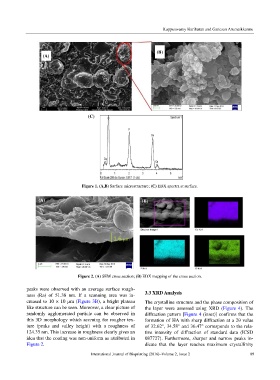
                                    Figure 1. (A,B) Surface microstructure; (C) EDX spectra at surface.

                 (A)                                         (B)


                                  Figure 2. (A) SEM cross section; (B) EDX mapping of the cross section.

            peaks were observed with an average surface rough-
            ness (Ra) of  51.38 nm. If a scanning  area was  in-  3.3 XRD Analysis
            creased to 10 × 10 µm (Figure 3B), a bright plateau   The crystalline structure and the phase composition of
            like structure can be seen. Moreover, a clear picture of   the layer were assessed  using XRD (Figure 4). The
            randomly  agglomerated  particle  can be observed in   diffraction pattern [Figure 4 (inset)] confirms that the
            this 3D morphology which accruing for rougher tex-  formation of HA with sharp diffraction at a 2θ value
            ture (peaks and valley height) with  a  roughness of   of 32.62°, 34.58° and 36.47° corresponds to the rela-
            124.35 nm. This increase in roughness clearly gives an   tive intensity of  diffraction of standard data (ICSD
            idea that the coating was non-uniform as attributed in   087727).  Furthermore, sharper and  narrow peaks  in-
            Figure 2.                                          dicate that the  layer reaches maximum crystallinity

                                        International Journal of Bioprinting (2016)–Volume 2, Issue 2      89

