


Page 140 - IJB-10-3
P. 140
International Journal of Bioprinting                               New challenges in liver tissue engineering


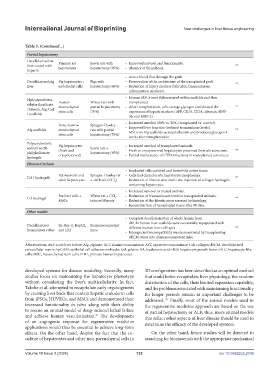
            Table 3. (Continued...)
             Partial hepatectomy
             Decellularized rat   Primary rat   Lewis rats with   –   Improved survival and functionality.
             liver coated with   hepatocytes  hepatectomy (90%)  –   Absence of thrombosis.          169
             heparin
                                                      –   Active blood flow through the graft.
             Decellularized pig  Pig hepatocytes +   Pigs with   –   Preservation of the architecture of the transplanted graft.  156
             liver        endothelial cells  hepatectomy (60%)  –   Reduction of injury markers (bilirubin, transaminases,
                                                        inflammation markers).
                                                      –   Human MSCs were differentiated within scaffolds and then
             Hydrolyzed tetra-  Human   Wistar rats with   transplanted.
             ethylorthosilicate,   mesenchymal   partial hepatectomy   –   After transplantation, cells storage glycogen and showed the   157
             chitosan, Alg, Col   stem cells  (70%)     expression of hepatic markers (AFP, CK19, CK18, albumin, HNF-
             I scaffolds
                                                        3b, and MRP-2).
                                                      –   Increased survival (80% vs. 50%, transplanted vs. control).
                          Bone marrow   Sprague–Dawley
             Alg scaffolds  mesenchymal   rats with partial   –   Improved liver function (reduced transaminase levels).  158
                                                      –   MSCs on Alg scaffolds secreted albumin and produced glycogen 4
                          stem cells    hepatectomy (70%)
                                                        weeks after transplantation.
             Polyacrylonitrile   Pig hepatocytes      –   Increased survival of transplanted animals.
             sodium meth-  (fresh and   Lewis rats +   –   Fresh or cryopreserved hepatocytes preserved their ultrastructure.  170
             ylallylsulfonate   cryopreserved)  hepatectomy (95%)   –   Partial maintenance of CYP3A4 activity in transplanted constructs.
             hydrogels
             Fibrosis/Cirrhosis
                                                      –   Implanted cells survived and hosted the native tissue.
                          Rat neonatal and   Sprague–Dawley rat  –   Cells had characteristic hepatocyte morphology.
             Col I hydrogels                                                                         163
                          adult hepatocytes   + cirrhosis (CCl )  –   Reduction of fibrosis after multi-site injection of collagen hydrogels
                                                  4
                                                        containing hepatocytes.
                                                      –   Increased survival in treated animals.
                          Rat liver cells +   Wistar rat + CCl -  –   Reduction of transaminases levels in transplanted animals.
             Col hydrogel                         4                                                  164
                          MSCs          induced fibrosis  –   Reduction of the fibrotic areas assessed by histology.
                                                      –   Reconstruction of transplanted tissue after 90 days.
             Other models
                                                      –   Complete decellularization of whole human liver.
                                                      –   dECM human liver scaffolds were successfully repopulated with
             Decellularized   Sk-Hep-1, HepG2,  Immunocompetent   different human liver cell types.  148
             human liver cubes  and LX2  mice
                                                      –   Interspecies biocompatibility was demonstrated by transplanting
                                                        dECM cubes into immunocompetent mice.
            Abbreviations: ALF, acute liver failure; Alg, alginate; ALT, alanine transaminase; AST, aspartate transaminase; Col, collagen; dECM, decellularized
            extracellular matrix; EpCAM, epithelial cell adhesion molecule; Gel, gelatin; HA, hyaluronic acid; HGF, hepatocyte growth factor; HLC, hepatocyte-like
            cells; MSC, mesenchymal stem cells; PHH, primary human hepatocytes.


            developed systems for disease modeling. Secondly, many   3D configuration has been described as an optimal method
            studies focus on maintaining the hepatocyte phenotype   that could better recapitulate liver physiology, the random
            without considering the liver’s multicellularity. In fact,   distribution of the cells, their limited expansion capability,
            Takebe et al. attempted to recapitulate early organogenesis   and the problems associated with maintaining functionality
            by creating liver buds that contain hepatic endoderm cells   for longer periods remain as important challenges to be
            from iPSCs, HUVECs, and MSCs and demonstrated their   addressed.  Finally, most of the animal models used in
                                                                       171
            increased functionality  in vitro, along with their ability   the regenerative medicine approach are based on the use
            to rescue an animal model of drug-induced lethal failure   of partial hepatectomy or ALF; thus, more animal models
            and achieve human vascularization.  The development   that reflect other aspects of liver disease should be used to
                                          83
            of an angiogenic response for regenerative medicine   determine the efficacy of the developed systems.
            applications would thus be essential to achieve long-term
            effects. On the other hand, despite the fact that the co-  On the other hand, future studies will be directed to
            culture of hepatocytes and other non-parenchymal cells in   searching for biomaterials with the appropriate mechanical


            Volume 10 Issue 3 (2024)                       132                                doi: 10.36922/ijb.2706

