


Page 521 - IJB-10-3
P. 521
International Journal of Bioprinting                                     Drop-on-demand laser bioprinting


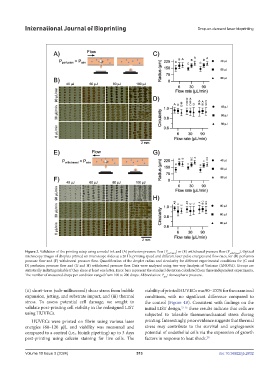
            Figure 2. Validation of the printing setup using a model ink and (A) perfusion pressure flow (P perfusion ) or (E) withdrawal pressure flow (P withdrawal ). Optical
            microscopy images of droplets printed on microscope slides at a 20 Hz printing speed and different laser pulse energies and flow rates, for (B) perfusion
            pressure flow and (F) withdrawal pressure flow. Quantification of the droplet radius and circularity for different experimental conditions for (C and
            D) perfusion pressure flow and (G and H) withdrawal pressure flow. Data were analyzed using two-way Analysis of Variance (ANOVA). Groups are
            statistically indistinguishable if they share at least one letter. Error bars represent the standard deviation calculated from three independent experiments.
            The number of measured drops per condition ranged from 100 to 200 drops. Abbreviation: P : Atmospheric pressure.
                                                                       atm

            (ii) short-term (sub-millisecond) shear stress from bubble   viability of printed HUVECs was 90–100% for the examined
            expansion, jetting, and substrate impact, and (iii) thermal   conditions, with no significant difference compared to
            stress. To assess potential cell damage, we sought to   the control (Figure 4B). Consistent with findings on the
            validate post-printing cell viability in the redesigned LIST   initial LIST design, 23-25  these results indicate that cells are
            using HUVECs.                                      subjected to tolerable thermomechanical stress during
               HUVECs were printed on fibrin using various laser   printing. Interestingly, prior evidence suggests that thermal
            energies  (60–120  μJ),  and  viability  was  measured  and   stress may contribute to the survival and angiogenesis
            compared to a control (i.e., bioink pipetting) up to 3 days   potential of endothelial cells via the expression of growth
            post-printing using calcein staining for live cells. The   factors in response to heat shock.
                                                                                         28

            Volume 10 Issue 3 (2024)                       513                                doi: 10.36922/ijb.2832

