


Page 522 - IJB-10-3
P. 522
International Journal of Bioprinting                                     Drop-on-demand laser bioprinting


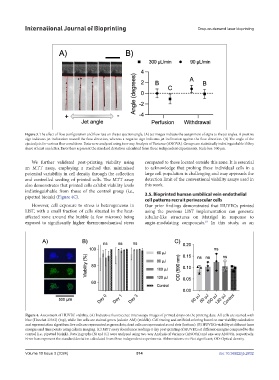
            Figure 3. The effect of flow configuration and flow rate on the jet ejection angle. (A) Jet images indicate the assignment of signs to the jet angles. A positive
            sign indicates jet inclination toward the flow direction, whereas a negative sign indicates jet inclination against the flow direction. (B) The angle of the
            ejected jets for various flow conditions. Data were analyzed using two-way Analysis of Variance (ANOVA). Groups are statistically indistinguishable if they
            share at least one letter. Error bars represent the standard deviation calculated from three independent experiments. Scale bar: 500 μm.

               We further validated post-printing viability using   compared to those located outside this zone. It is essential
            an MTT assay, employing a method that minimized    to acknowledge that probing these individual cells in a
            potential variability in cell density through the collection   large cell population is challenging and may approach the
            and controlled seeding of printed cells. The MTT assay   detection limit of the conventional viability assays used in
            also demonstrates that printed cells exhibit viability levels   this work.
            indistinguishable from those of the control group (i.e.,
            pipetted bioink) (Figure 4C).                      3.5. Bioprinted human umbilical vein endothelial
                                                               cell patterns recruit perivascular cells
               However, cell exposure to stress is heterogeneous in   Our prior findings demonstrated that HUVECs printed
            LIST, with a small fraction of cells situated in the heat-  using the previous LIST implementation can generate
            affected zone around the bubble (a few microns) being   tubular-like structures  on Matrigel  in response  to
            exposed to significantly higher thermomechanical stress   angio-modulating compounds.  In this study, as an
                                                                                         23


            Figure 4. Assessment of HUVEC viability. (A) Indicative fluorescence microscopy images of printed drops on the printing date. All cells are stained with
            blue (Hoechst 33342) (top), while live cells are stained green (calcein AM) (middle). Cell tracing and artificial coloring based on our viability calculation
            and representation algorithm: live cells are represented as green dots; dead cells are represented as red dots (bottom). (B) HUVECs viability at different laser
            energies and time points using calcein imaging. (C) MTT assay absorbance readings 1 day post-printing of HUVECs at different energies compared to the
            control (i.e., pipetted bioink). Data in graphs (B) and (C) were analyzed using two-way Analysis of Variance (ANOVA) and one-way ANOVA, respectively.
            Error bars represent the standard deviation calculated from three independent experiments. Abbreviations: ns: Not significant; OD: Optical density.


            Volume 10 Issue 3 (2024)                       514                                doi: 10.36922/ijb.2832

