


Page 523 - IJB-10-3
P. 523
International Journal of Bioprinting                                     Drop-on-demand laser bioprinting


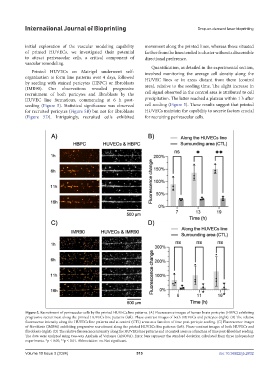
            initial exploration of the vascular modeling capability   movement along the printed lines, whereas those situated
            of printed HUVECs, we investigated their potential   farther from the lines tended to cluster without a discernible
            to attract perivascular cells, a critical component of   directional preference.
            vascular remodeling.
                                                                  Quantification, as detailed in the experimental section,
               Printed HUVECs on Matrigel underwent self-      involved monitoring the average cell density along the
            organization to form line patterns over 4 days, followed   HUVEC lines or in areas distant from them (control
            by seeding with stained pericytes (HBPC) or fibroblasts
            (IMR90).  Our  observations  revealed  progressive  area), relative to the seeding time. The slight increase in
            recruitment of both pericytes and fibroblasts by the   cell signal observed in the control area is attributed to cell
            HUVEC line formations, commencing at 6 h post-     precipitation. The latter reached a plateau within 1 h after
            seeding (Figure 5). Statistical significance was observed   cell seeding (Figure 5). These results suggest that printed
            for recruited pericytes (Figure 5B) but not for fibroblasts   HUVECs maintain the capability to secrete factors crucial
            (Figure 5D). Intriguingly, recruited cells exhibited   for recruiting perivascular cells.


            Figure 5. Recruitment of perivascular cells by the printed HUVECs line patterns. (A) Fluorescence images of human brain pericytes (HBPC) exhibiting
            progressive recruitment along the printed HUVECs line patterns (left). Phase-contrast images of both HUVECs and pericytes (right). (B) The relative
            fluorescence intensity along the HUVECs line patterns and at control (CTL) areas as a function of time post-pericyte seeding. (C) Fluorescence images
            of fibroblasts (IMR90) exhibiting progressive recruitment along the printed HUVECs line patterns (left). Phase-contrast images of both HUVECs and
            fibroblasts (right). (D) The relative fluorescence intensity along the HUVECs line patterns and at control areas as a function of time post-fibroblast seeding.
            The data were analyzed using two-way Analysis of Variance (ANOVA). Error bars represent the standard deviation calculated from three independent
            experiments. *p ≤ 0.05; **p ≤ 0.01. Abbreviation: ns: Not significant.

            Volume 10 Issue 3 (2024)                       515                                doi: 10.36922/ijb.2832

