


Page 528 - IJB-10-3
P. 528
International Journal of Bioprinting                                Mechanical responses of 3D-printed AFO


            1. Introduction                                    modeling (FDM), 15-19  multijet  fusion (MJF),  selective
                                                                                                    20
                                                               laser sintering (SLS), 21,22  and stereolithography (SLA),
                                                                                                            23
            Gait deviations are a common problem in ambulant   to manufacture AFOs. As presented in  Figure 1b, the
            children with cerebral palsy (CP) due to a combination   fabrication processes of 3D-printed AFOs start with
            of impaired motor control, movement disorders such as   the acquisition of the patient-specific geometry using
            spasticity, and secondary musculoskeletal deformities such   3D-scanning, microcomputed tomography (CT), or
            as  equinus  contractures.   Besides  single-event multilevel
                                1
            surgery,  nonoperative management options to improve gait   magnetic resonance imaging (MRI) data. Subsequently, a
                  2
            impairments include physical therapy,  pharmacological   smooth foot-leg model can be reconstructed by repairing
                                           3
                                                               and fitting raw scanning data. AFOs can be designed based
            interventions (e.g., injections of botulinum toxin A),
                                                         4,5
            and  the  use  of  an  ankle-foot  orthosis  (AFO).   AFOs   on the foot-leg model according to clinical requirements
                                                   6-8
            are externally  applied  devices  encompassing the  foot,   using computer-aided design (CAD) software, followed
            ankle, and leg from just below the knee. They are used to   by converting the design to G-code compatible with the
            compensate for impairments in the structure and function   3D printer for printing. Finally, the 3D-printed AFO can
            of the neuromuscular and musculoskeletal systems.    be inspected and delivered to the patient (Figure 1b).
                                                         7,9
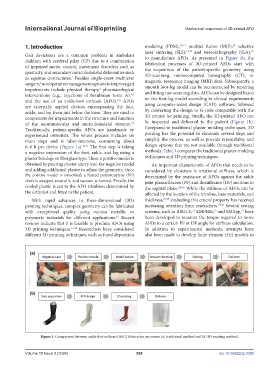
            Traditionally, patient-specific AFOs are handmade by   Compared to traditional plaster molding techniques, 3D
            experienced orthotists. The whole process includes six   printing has  the  potential to  eliminate several steps  and
            main steps and is labor-intensive, consuming about   simplify the process, as well as provide repeatability and
            6–8 h per device (Figure 1a). 10,11  The first step is taking   design options that are not available through traditional
            a negative impression of the foot, ankle, and leg using a   methods. Table 1 compares the traditional plaster-molding
            plaster bandage or fiberglass type. Then, a positive model is   techniques and 3D printing techniques.
            obtained by pouring plaster slurry into the negative model   An important characteristic of AFOs that needs to be
            and adding additional plaster to adjust the geometry. Once   considered by clinicians is rotational stiffness, which is
            the positive model is smoothed, a heated polypropylene (PP)   determined by the resistance of AFOs against the ankle
            sheet is wrapped around it, and vacuum is formed. Finally, the   joint plantarflexion (PF) and dorsiflexion (DF) motions in
            cooled plastic is cut to the AFO trimlines determined by   the sagittal plane. 24-26  While the stiffness of AFOs can be
            the orthotist and fitted to the patient.           affected by the location of the trimline, base materials, and
               With rapid advances in three-dimensional (3D)   thickness, 27,28  evaluating this crucial property has received
            printing techniques, complex geometry can be fabricated   increasing attention from researchers. 29,30  Several testing
            with exceptional quality using various metallic or   systems, such as BRUCE,  EMPIRE,  and SMApp,  have
                                                                                                        33
                                                                                            32
                                                                                   31
                                                   12
            polymeric materials for different applications.  Recent   been developed to measure the torque required to move
            reviews indicate that it is feasible to produce AFOs using   AFOs to a certain PF or DF angle for stiffness calculation.
            3D printing techniques. 13,14  Researchers have considered   In  addition to experimental methods, attempts  have
            different 3D printing techniques, such as fused deposition   also been made to develop finite element (FE) models to


                  Figure 1. Comparison between ankle-foot orthosis (AFO) fabrication processes: (a) traditional method and (b) 3D printing method.


            Volume 10 Issue 3 (2024)                       520                                doi: 10.36922/ijb.3390

