


Page 531 - IJB-10-3
P. 531
International Journal of Bioprinting                                Mechanical responses of 3D-printed AFO


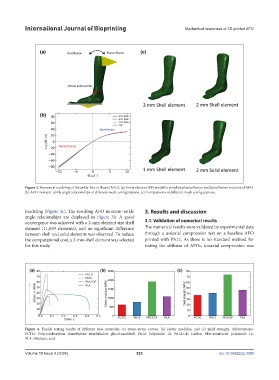
            Figure 3. Numerical modeling of the ankle-foot orthosis (AFO). (a) Finite element (FE) model to simulate plantarflexion and dorsiflexion motions of AFO.
            (b) AFO moment–ankle angle relationships of different mesh configurations. (c) Comparisons of different mesh configurations.


            modeling (Figure 3c). The resulting AFO moment–ankle   3. Results and discussion
            angle relationships are displayed in  Figure 3b. A good
            convergence was achieved with a 2-mm element size shell   3.1. Validation of numerical results
            element (11,659 elements), and no significant difference   The numerical results were validated by experimental data
            between shell and solid elements was observed. To reduce   through a uniaxial compression test on a baseline AFO
            the computational cost, a 2-mm shell element was selected   printed with PA12.  As there  is no standard method for
            for this study.                                    testing the stiffness of AFOs, uniaxial compression was


            Figure 4.  Tensile testing results of different base materials: (a) stress–strain curves, (b) elastic modulus, and (c) yield strength. Abbreviations:
            PCTG: Polycyclohexylene dimethylene terephthalate glycol-modified; PA12: Polyamide 12; PA12-CF: Carbon fiber-reinforced polyamide 12;
            PLA: Polylactic acid.


            Volume 10 Issue 3 (2024)                       523                                doi: 10.36922/ijb.3390

