


Page 534 - IJB-10-3
P. 534
International Journal of Bioprinting                                Mechanical responses of 3D-printed AFO


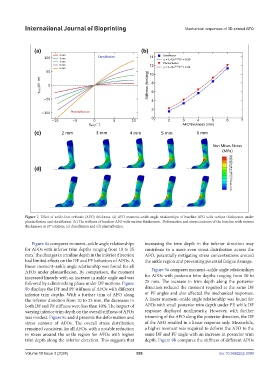
            Figure 7. Effect of ankle-foot orthosis (AFO) thickness. (a) AFO moment–ankle angle relationships of baseline AFO with various thicknesses under
            plantarflexion and dorsiflexion. (b) The stiffness of baseline AFO with various thicknesses.  Deformation and stress contours of the baseline with various
            thicknesses at 10° rotation: (c) dorsiflexion and (d) plantarflexion.


               Figure 8a compares moment–ankle angle relationships   increasing the trim depth in the inferior direction may
            for AFOs with inferior trim depths ranging from 10 to 25   contribute to a more even stress distribution across the
            mm. The changes in trimline depth in the inferior direction   AFO, potentially mitigating stress concentrations around
            had limited effects on the DF and PF behaviors of AFOs. A   the ankle region and preventing potential fatigue damage.
            linear moment–ankle angle relationship was found for all
            AFOs under plantarflexion. By comparison, the moment   Figure 9a compares moment–ankle angle relationships
            increased linearly with an increase in ankle angle and was   for AFOs with posterior trim depths ranging from 10 to
            followed by a diminishing phase under DF motions. Figure   25  mm.  The  increase  in  trim  depth  along  the  posterior
            8b displays the DF and PF stiffness of AFOs with different   direction reduced the moment required at the same DF
            inferior trim depths. With a further trim of AFO along   or PF angles and also affected the mechanical responses.
            the inferior direction from 10 to 25 mm, the decreases in   A linear moment–ankle angle relationship was found for
            both DF and PF stiffness were less than 10%. The impact of   AFOs with small posterior trim depth under PF, while DF
            varying inferior trim depth on the overall stiffness of AFOs   response displayed nonlinearity. However, with further
            was modest. Figure 8c and d presents the deformation and   trimming of the AFO along the posterior direction, the DF
            stress contour of AFOs. The overall stress distribution   of the AFO resulted in a linear response only. Meanwhile,
            remained consistent for all AFOs, with a notable reduction   a higher moment was required to deform the AFO to the
            in stress around the ankle region for AFOs with higher   same DF and PF angle with an increase in posterior trim
            trim depth along the inferior direction. This suggests that   depth. Figure 9b compares the stiffness of different AFOs

            Volume 10 Issue 3 (2024)                       526                                doi: 10.36922/ijb.3390

