


Page 535 - IJB-10-3
P. 535
International Journal of Bioprinting                                Mechanical responses of 3D-printed AFO


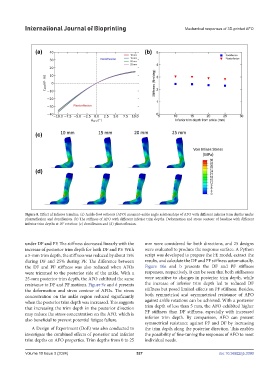
            Figure 8. Effect of inferior trimline. (a) Ankle-foot orthosis (AFO) moment–ankle angle relationships of AFO with different inferior trim depths under
            plantarflexion and dorsiflexion. (b) The stiffness of AFO with different inferior trim depths. Deformation and stress contour of baseline with different
            inferior trim depths at 10° rotation: (c) dorsiflexion and (d) plantarflexion.


            under DF and PF. The stiffness decreased linearly with the   mm were considered for both directions, and 25 designs
            increase of posterior trim depth for both DF and PF. With   were evaluated to produce the response surface. A Python
            a 5-mm trim depth, the stiffness was reduced by about 15%   script was developed to prepare the FE model, extract the
            during DF and 25% during PF. The difference between   results, and calculate the DF and PF stiffness automatically.
            the DF and PF stiffness was also reduced when AFOs   Figure  10a  and  b  presents  the  DF  and  PF  stiffness
            were trimmed to the posterior side of the ankle. With a   responses, respectively. It can be seen that both stiffnesses
            25-mm posterior trim depth, the AFO exhibited the same   were sensitive to changes in posterior trim depth, while
            resistance to DF and PF motions. Figure 9c and d presents   the increase of inferior trim depth led to reduced DF
            the deformation and stress contour of AFOs. The stress   stiffness but posed limited effects on PF stiffness. Besides,
            concentration on the ankle region reduced significantly   both symmetrical and asymmetrical resistance of AFO
            when the posterior trim depth was increased. This suggests   against ankle rotations can be achieved. With a posterior
            that increasing the trim depth in the posterior direction   trim depth of less than 5 mm, the AFO exhibited higher
            may reduce the stress concentration on the AFO, which is   PF stiffness than DF stiffness, especially with increased
            also beneficial to prevent potential fatigue failure.   inferior  trim depth. By comparison, AFO can present
                                                               symmetrical resistance against PF and DF by increasing
               A Design of Experiment (DoE) was also conducted to   the trim depth along the posterior direction. This enables
            investigate the combined effects of posterior and inferior   the possibility of fine-tuning the responses of AFO to meet
            trim depths on AFO properties. Trim depths from 0 to 25   individual needs.

            Volume 10 Issue 3 (2024)                       527                                doi: 10.36922/ijb.3390

