


Page 533 - IJB-10-3
P. 533
International Journal of Bioprinting                                Mechanical responses of 3D-printed AFO


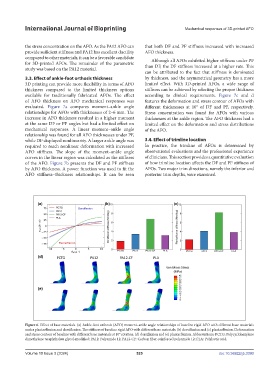
            the stress concentration on the AFO. As the PA12 AFO can   that both DF and PF stiffness increased with increased
            provide sufficient stiffness and PA12 has excellent ductility   AFO thickness.
            compared to other materials, it can be a favorable candidate   Although all AFOs exhibited higher stiffness under PF
            for 3D-printed AFOs. The remainder of the parametric   than DF, the DF stiffness increased at a higher rate. This
            study was based on the PA12 material.
                                                               can  be  attributed  to  the  fact  that  stiffness  is  dominated
            3.3. Effect of ankle-foot orthosis thickness       by thickness, and the asymmetrical geometry has a more
            3D printing can provide more flexibility in terms of AFO   limited effect. With 3D-printed AFOs, a wide range of
            thickness compared to the limited thickness options   stiffness can be achieved by selecting the proper thickness
            available for traditionally fabricated AFOs. The effect   according to clinical requirements.  Figure 7c and d
            of AFO thickness on AFO mechanical responses was   features the deformation and stress contour of AFOs with
            evaluated.  Figure 7a compares moment–ankle angle   different  thicknesses  at 10°  of  DF  and PF,  respectively.
            relationships for AFOs with thicknesses of 2–6 mm. The   Stress concentration was found for AFOs with various
            increase in AFO thickness resulted in a higher moment   thicknesses at the ankle region. The AFO thickness had a
            at the same DF or PF angles but had a limited effect on   limited effect on the deformation and stress distributions
            mechanical  responses.  A  linear  moment–ankle  angle   of the AFO.
            relationship was found for all AFO thicknesses under PF,
            while DF displayed nonlinearity. A larger ankle angle was   3.4. Effect of trimline location
            required to reach nonlinear deformation with increased   In practice, the trimline of AFOs is determined by
            AFO stiffness. The slope of the moment–ankle angle   observational evaluations and the professional experience
            curves in the linear region was calculated as the stiffness   of clinicians. This section provides a quantitative evaluation
            of the AFO. Figure 7b presents the DF and PF stiffness   of how trimline location affects the DF and PF stiffness of
            by AFO thickness. A power function was used to fit the   AFOs. Two major trim directions, namely the inferior and
            AFO stiffness–thickness relationships. It  can be  seen   posterior trim depths, were examined.


            Figure 6. Effect of base materials. (a) Ankle-foot orthosis (AFO) moment–ankle angle relationships of baseline rigid AFO with different base materials
            under plantarflexion and dorsiflexion. The stiffness of baseline rigid AFO with different base materials: (b) dorsiflexion and (c) plantarflexion. Deformation
            and stress contour of baseline with different base materials at 10° rotation: (d) dorsiflexion and (e) plantarflexion. Abbreviations: PCTG: Polycyclohexylene
            dimethylene terephthalate glycol-modified; PA12: Polyamide 12; PA12-CF: Carbon fiber-reinforced polyamide 12; PLA: Polylactic acid.


            Volume 10 Issue 3 (2024)                       525                                doi: 10.36922/ijb.3390

