


Page 532 - IJB-10-3
P. 532
International Journal of Bioprinting                                Mechanical responses of 3D-printed AFO


            chosen  to  provide more controllable testing  conditions.   behaviors under PF and DF loading. A linear moment–
            The displacement control method was utilized in the test   ankle angle relationship was found for all AFOs under
            with a  loading rate of 1 mm/min  to eliminate dynamic   PF loading. In comparison, the moment first increased
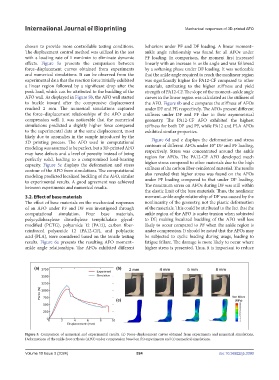
            effects.  Figure 5a presents the comparison between   linearly with an increase in ankle angle and was followed
            force–displacement curves obtained from experiments   by a softening phase under DF loading. It was noticeable
            and numerical simulations. It can be observed from the   that the ankle angle required to reach the nonlinear region
            experimental data that the reaction force initially exhibited   was significantly higher for PA12-CF compared to other
            a linear region followed by a significant drop after the   materials, attributing to the higher stiffness and yield
            peak load, which can be attributed to the buckling of the   strength of PA12-CF. The slope of the moment–ankle angle
            AFO wall. As displayed in Figure 5b, the AFO wall started   curves in the linear region was calculated as the stiffness of
            to buckle inward after the compressive displacement   the AFO. Figure 6b and c compares the stiffness of AFOs
            reached 2 mm. The numerical simulations captured   under DF and PF, respectively. The AFOs present different
            the force–displacement relationships of the AFO under   stiffness under DF and PF due to their asymmetrical
            compression well. It was noticeable that the numerical   geometry. The  PA12-CF  AFO  exhibited the  highest
            simulations predicted a slightly higher force compared   stiffness for both DF and PF, while PA12 and PLA AFOs
            to the experimental data at the same displacement, most   exhibited similar properties.
            likely due to anomalies in the sample introduced by the   Figure 6d and e displays the deformation and stress
            3D printing process. The AFO used in computational   contours of different AFOs under 10° DF and PF loading,
            modeling was assumed to be perfect, but a 3D-printed AFO   respectively. Stress was concentrated around the ankle
            may have defects and a level of porosity instead of being
            perfectly solid, leading to a compromised load-bearing   region  for  AFOs.  The  PA12-CF  AFO  developed  much
            capacity.  Figure 5c displays the deformation and stress   higher stress compared to other materials due to the high
            contour of the AFO from simulations. The computational   stiffness of the carbon fiber-reinforced material. The results
            modeling predicted localized buckling of the AFO, similar   also revealed that higher stress was found on the AFOs
            to experimental results. A good agreement was achieved   under PF loading compared to that under DF loading.
            between experiments and numerical results.         The maximum stress on AFOs during DF was still within
                                                               the elastic limit of the base materials. Thus, the nonlinear
            3.2. Effect of base materials                      moment–ankle angle relationship of DF was caused by the
            The effect of base materials on the mechanical responses   nonlinearity of the geometry, not the plastic deformation
            of an AFO under PF and DF was investigated through   of the materials. This could be attributed to the fact that the
            computational  simulation.  Four  base  materials,  ankle region of the AFO is under tension when subjected
            polycyclohexylene dimethylene terephthalate glycol-  to DF, making localized buckling of the AFO wall less
            modified (PCTG), polyamide 12 (PA12), carbon fiber-  likely to occur compared to PF when the ankle region is
            reinforced polyamide 12 (PA12-CF), and polylactic   under compression. It should be noted that the AFOs may
            acid (PLA), were considered based on the tensile testing   be subjected to cyclic loading during usage, leading to
            results.  Figure 6a presents the resulting AFO moment–  fatigue failure. The damage is more likely to occur where
            ankle angle relationships. The AFOs exhibited different   higher stress is presented. Thus, it is important to reduce


            Figure 5. Comparison of numerical and experimental results. (a) Force–displacement curves obtained from experiments and numerical simulations.
            Deformations of the ankle-foot orthosis (AFO) under compression based on (b) experiments and (c) numerical simulations.


            Volume 10 Issue 3 (2024)                       524                                doi: 10.36922/ijb.3390

