


Page 529 - IJB-10-3
P. 529
International Journal of Bioprinting                                Mechanical responses of 3D-printed AFO


            Table 1. Comparison between traditional methods and 3D   a baseline AFO design is created and 3D printed. An FE
            printing for ankle-foot orthosis (AFO) production  model is developed and validated using experimental
                                                               data. A parametric study on the effect of base materials,
             Parameter        Traditional     3D printing
                              techniques      techniques       thickness, and trimline location is conducted. The results
             Material options   Limited     Most engineering   provide insights into the development and customization
                                             thermoplastics    of 3D-printed AFOs for individuals with specific ankle and
             Labor requirement   Skilled       Technical       foot conditions.
             Material waste     High             Low           2. Methods
             Design             Low             High
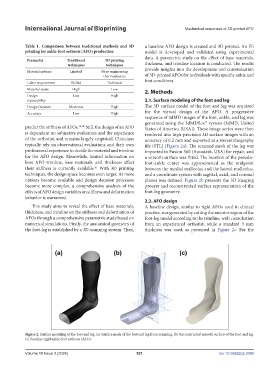
             repeatability                                     2.1. Surface modeling of the foot and leg
             Design freedom   Moderate          High           The 3D surface model of the foot and leg was acquired
                                                               for the virtual design of the AFO. A progressive
             Accuracy           Low             High
                                                               sequence of 3dMD images of the foot, ankle, and leg was
                                                               generated using the 3dMDflex™ system (3dMD, United
            predict the stiffness of AFOs. 34-40  Still, the design of an AFO   States of America [USA]). These image series were then
            is dependent on subjective evaluation and the experience   rendered into high-precision 3D surface images with an
            of the orthotist, and remains largely empirical. Clinicians   accuracy of 0.2 mm and exported as a stereolithography
            typically rely on observational evaluations and their own   file (STL) (Figure 2a). The scanned mesh of the leg was
            professional experience to decide the material and trimline   imported to Fusion 360 (Autodesk, USA) for repair, and
            for the AFO design. Meanwhile, limited information on   a smooth surface was fitted. The location of the pseudo-
            how  AFO  trimline,  base  materials,  and  thickness  affect   foot-ankle center was approximated as the midpoint
            their stiffness is currently available.  With 3D printing   between the medial malleolus and the lateral malleolus,
                                         41
            techniques, the design space becomes even larger. As more   and a coordinate system with sagittal, axial, and coronal
            options become available and design decision processes   planes was defined. Figure 2b presents the 3D imaging
            become more complex, a comprehensive analysis of the   process and reconstructed surface representation of the
            effects of AFO design variables on stiffness and deformation   foot-leg geometry.
            behavior is warranted.
                                                               2.2. AFO design
               This study aims to reveal the effect of base materials,   A baseline design, similar to rigid AFOs used in clinical
            thickness, and trimline on the stiffness and deformation of   practice, was generated by cutting the anterior region of the
            AFOs through a comprehensive parametric study based on   foot-leg model according to the trimline, with consultation
            numerical simulations. Firstly, the anatomical geometry of   from an experienced orthotist, while a standard 3 mm
            the foot-leg is established by a 3D-scanning system. Then,   thickness  was  used,  as  presented  in  Figure  2c.  For  the


            Figure 2. Surface modeling of the foot and leg. (a) Surface mesh of the foot and leg from scanning. (b) Reconstructed smooth surface of the foot and leg.
            (c) Baseline rigid ankle-foot orthosis (AFO).


            Volume 10 Issue 3 (2024)                       521                                doi: 10.36922/ijb.3390

