


Page 519 - IJB-10-3
P. 519
International Journal of Bioprinting                                     Drop-on-demand laser bioprinting


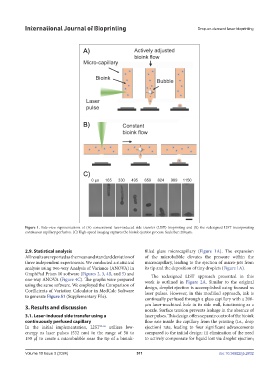
            Figure 1. Side-view representations of (A) conventional laser-induced side transfer (LIST) bioprinting and (B) the redesigned LIST incorporating
            continuous capillary perfusion. (C) High-speed imaging captures the bioink ejection process. Scale bar: 200 μm.


            2.9. Statistical analysis                          filled glass microcapillary (Figure 1A). The expansion
            All results are reported as the mean and standard deviation of   of  the  microbubble  elevates  the  pressure  within  the
            three independent experiments. We conducted a statistical   microcapillary, leading to the ejection of micro-jets from
            analysis using two-way Analysis of Variance (ANOVA) in   its tip and the deposition of tiny droplets (Figure 1A).
            GraphPad Prism 10 software (Figures 2, 3, 4B, and 5) and   The redesigned LIST approach presented in this
            one-way ANOVA (Figure 4C). The graphs were prepared   work is outlined in  Figure 2A. Similar to the original
            using the same software. We employed the Comparison of   design, droplet ejection is accomplished using focused ns
            Coefficients of Variation Calculator in MedCalc Software   laser pulses. However, in this modified approach, ink is
            to generate Figure S1 (Supplementary File).
                                                               continually perfused through a glass capillary with a 200-
                                                               μm laser-machined hole in its side wall, functioning as a
            3. Results and discussion                          nozzle. Surface tension prevents leakage in the absence of
            3.1. Laser-induced side transfer using a           laser pulses. This design offers separate control of the bioink
            continuously perfused capillary                    flow rate inside the capillary from the printing (i.e., drop
            In the initial implementation, LIST 23-26  utilizes low-  ejection) rate, leading to four significant advancements
            energy ns laser pulses (532 nm) in the range of 50 to   compared to the initial design: (i) elimination of the need
            150 μJ to create a microbubble near the tip of a bioink-  to actively compensate for liquid lost via droplet ejection;


            Volume 10 Issue 3 (2024)                       511                                doi: 10.36922/ijb.2832

