


Page 568 - IJB-10-3
P. 568
International Journal of Bioprinting                                         Bioprint micro breast cancer


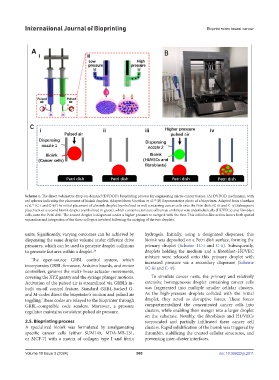
            Scheme 1. The direct volumetric drop-on-demand (DVDOD) bioprinting process for engineering micro-cancer tissues. (A) DVDOD mechanism, with
            red spheres indicating the placement of bioink droplets. Adapted from Grottkau et al.  (B) Representative photo of a bioprinter. Adapted from Grottkau
                                                                   14
            et al.  (C-i and C-ii) The initial placement of a bioink droplet (symbolized in red) containing cancer cells onto the Petri dish. (C-iii and C-iv) Subsequent
               13
            placement of a second bioink droplet (symbolized in green), which contains a mixture of human umbilical vein endothelial cells (HUVECs) and fibroblast
            cells, onto the Petri dish. The second droplet is dispensed under a higher pressure to merge it with the first. This collision-like action incurs both spatial
            separation and integration of the three cell types involved following the merging of the two droplets.
            units. Significantly, varying outcomes can be achieved by   hydrogels. Initially, using a designated dispenser, this
            dispensing the same droplet volume under different drive   bioink was deposited on a Petri dish surface, forming the
            pressures, which can be used to generate droplet collisions   primary droplet (Scheme 1C-i  and  C-ii). Subsequently,
            to generate features within a droplet. 14          droplets holding the medium and a fibroblast–HUVEC
                                                               mixture were released onto this primary droplet with
               The open-source GRBL control system, which      increased pressure via a secondary dispenser (Scheme
            incorporates GRBL firmware, Arduino boards, and motor   1C-iii and C-iv).
            controllers, governs the multi-linear actuator movements,
            covering the XYZ gantry and the syringe plunger motions.   To simulate cancer nests,  the primary and relatively
            Activation of the pulsed air is streamlined via GRBL’s in-  extensive homogeneous droplet containing cancer cells
            built on-off control feature. Standard GRBL-backed G-   was fragmented into multiple smaller cellular clusters.
            and M-codes direct the bioprinter’s motion and pulsed air   As  the  high-pressure  droplets  collided  with  the  initial
            toggling. These codes are relayed to the bioprinter through   droplet, they acted as disruptive forces. These forces
            GRBL-compatible code senders. Moreover, a pressure   compartmentalized the concentrated cancer cells into
            regulator maintains consistent pulsed air pressure.  clusters, while enabling their merger into a larger droplet
                                                               on the substrate. Notably, the fibroblasts and HUVECs
            2.5. Bioprinting process                           surrounded and partially infiltrated these cancer cell
            A specialized bioink was formulated by amalgamating   clusters. Rapid solidification of the bioink was triggered by
            specific cancer cells (either SUM149, MDA-MB-231,   thrombin, stabilizing the created cellular structures, and
            or MCF-7) with a matrix of collagen type I and fibrin   preventing inter-cluster interfaces.


            Volume 10 Issue 3 (2024)                       560                                doi: 10.36922/ijb.2911

