


Page 572 - IJB-10-3
P. 572
International Journal of Bioprinting                                         Bioprint micro breast cancer


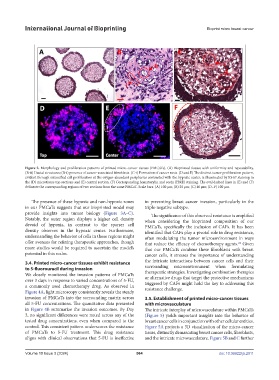
            Figure 2. Morphology and proliferation patterns of printed micro-cancer tissues (PMCaTs). (A) Bioprinted tissues with uniformity and repeatability.
            (B-ii) Ductal structures; (B-i) presence of cancer-associated fibroblasts. (C-i) Formation of cancer nests. (D and E) The distinct tumor proliferation pattern,
            evident through intensified cell proliferation at the oxygen-abundant peripheries contrasted with the hypoxic center, is illuminated by Ki-67 staining in
            the (D) microtissue top sections and (E) central section. (F) Corresponding hematoxylin and eosin (H&E) staining. The oval dashed lines in (E) and (F)
            delineate the corresponding regions of two sections from the same PMCaT. Scale bars: (A) 100 μm; (B) 20 μm; (C) 40 μm; (D–F) 100 μm.


               The presence of these hypoxic and non-hypoxic zones   in  preventing  breast  cancer  invasion,  particularly  in  the
            in our PMCaTs suggests that our bioprinted model may   triple-negative subtype.
            provide insights into tumor biology (Figure 3A–C).    The significance of this observed resistance is amplified
            Notably, the outer region displays a higher cell density   when considering the bioprinted composition of our
            devoid of hypoxia, in contrast to the sparser cell   PMCaTs,  specifically  the  inclusion  of  CAFs.  It  has been
            density  observes in  the  hypoxic  center.  Furthermore,   identified that CAFs play a pivotal role in drug resistance,
            understanding the behavior of cells in these regions might   often modulating the tumor microenvironment in ways
            offer avenues for refining therapeutic approaches, though   that reduce the efficacy of chemotherapy agents.  Given
                                                                                                       24
            more studies would be required to ascertain the model’s   that our PMCaTs combine these fibroblasts with breast
            potential in this realm.                           cancer cells, it stresses the importance of understanding
            3.4. Printed micro-cancer tissues exhibit resistance   the intricate interactions between cancer cells and their
            to 5-fluorouracil during invasion                  surrounding  microenvironment  when  formulating
                                                               therapeutic strategies. Investigating combination therapies
            We closely monitored the invasion patterns of PMCaTs
            over 3 days in response to varied concentrations of 5-FU,   or alternative drugs that target the protective mechanisms
            a  commonly  used  chemotherapy  drug.  As  observed  in   triggered by CAFs might hold the key to addressing this
            Figure 4A, light microscopy consistently reveals the steady   resistance challenge.
            invasion of PMCaTs into the surrounding matrix across   3.5. Establishment of printed micro-cancer tissues
            all 5-FU concentrations. The quantitative data presented   with microvasculature
            in Figure 4B summarize the invasion outcomes. By Day   The intricate interplay of microvasculature within PMCaTs
            3, no significant differences were noted across any of the   (Figure 5) yields important insights into the behavior of
            tested drug concentrations, even when compared to the   breast cancer cells in conjunction with other cellular entities.
            control. This consistent pattern underscores the resistance   Figure 5A projects a 3D visualization of the micro-cancer
            of  PMCaTs  to  5-FU  treatment.  This  drug  resistance   tissue, distinctly demarcating breast cancer cells, fibroblasts,
            aligns with clinical observations that 5-FU is ineffective   and the intricate microvasculature. Figure 5B and C further


            Volume 10 Issue 3 (2024)                       564                                doi: 10.36922/ijb.2911

